


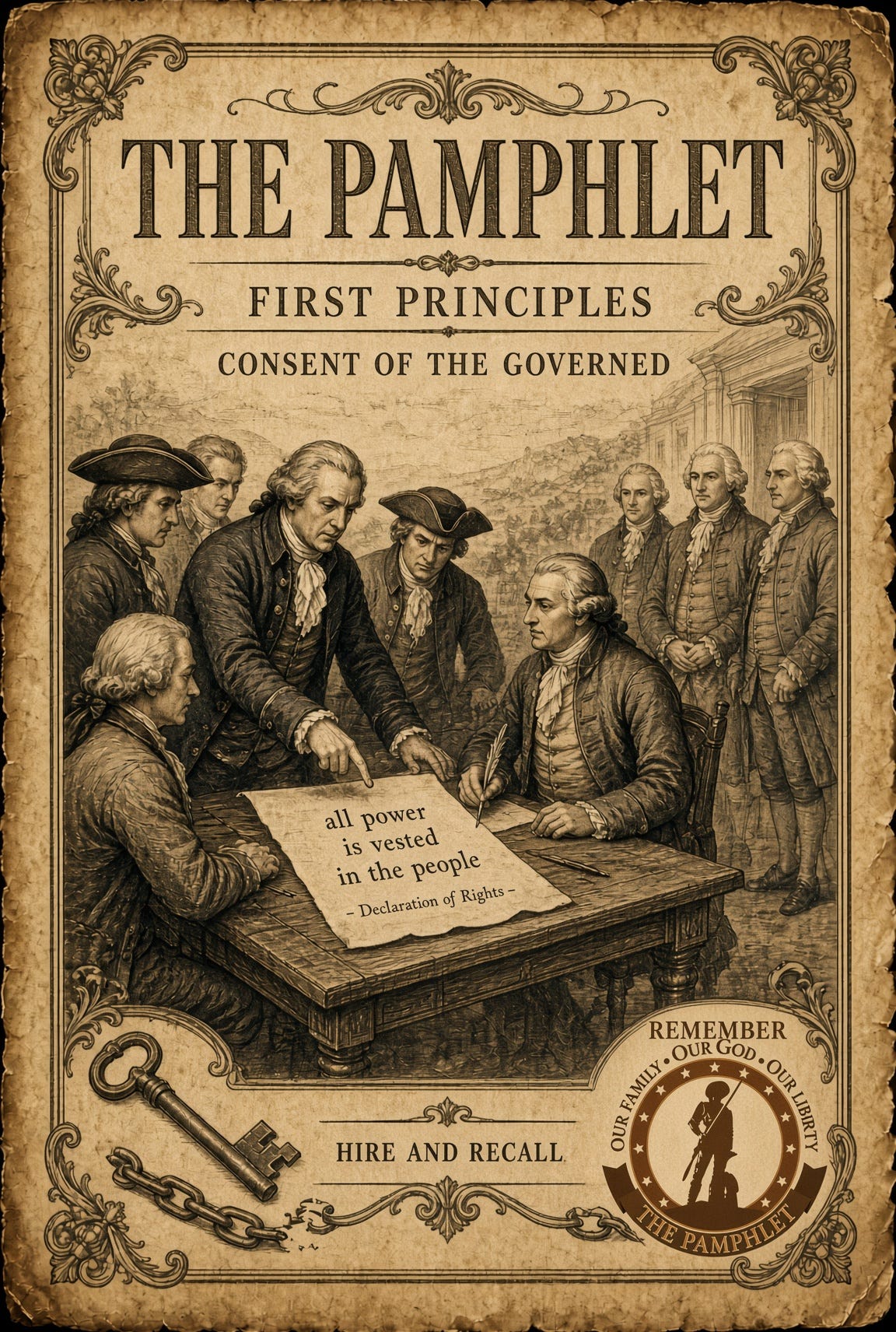
Today we leave the guns of Yorktown behind and return to the first principles of liberty. In order for men to assemble and stand up for themselves or vote to establish a fleet of ships we must first examine where that authority comes from. Today we go back to the one word that makes both of those acts lawful. Consent. Ponder that word a moment before we move on. Now what does it mean that all political power is derived from the consent of the people? Certainly, in its raw form we hire a public servant to handle the administration of that authority which we loan out. It means we hire our politicians and that we can fire them or revoke our authority that was loaned to them if they turn tyrannical. It is the reason a politician is a trustee and not an owner or issuer of our rights. If you have been told that government creates the rights and then lends them back to you on good behavior, you have been lied to. We have explained in recent articles that the men who taught the Founders, and the states that wrote the first declarations, put the order the other way around. The right is already yours and you don’t need permission to live your life, you have an obligation to respect others’ rights, but you don’t need permission to obtain yours. The office, whatever the title, from dog catcher to president is just a temporary employee. Again, to be clear, you can fire the hired.
As usual I don’t want you to take my word for it, and if you don’t trust your own consciousness let’s turn to an expert on the subject. John Locke said it plainly in the Second Treatise on Government and our Founding Fathers relied on his work to inform them of the aspects of government and inalienable rights. Every man is naturally free. Nothing can put him into subjection to any earthly power but his own consent. Certainly, there are wicked and tyrannical voices that seek to compel, trick, or force you, but that would bring up the right of self-defense which is a different article. This is the complete and simple definition; you are born free and you only give up that liberty by consent whether that consent be willful of by other means. Force does not create a right in the man who uses it, but another way might does not make right. A king does not become your owner because he has a crown, he only becomes that if you allow him to and even then, it does not validate his authority. I hope our writings help you to realize that self-determination is as the heart of every aspect of liberty and without it one is simply a slave by another name. A legislature does not become your owner because it has a seal, a fancy pin, or because they assemble in guided chambers with contempt for liberty of the people. Locke asks his readers to consider what counts as consent and I think it is a fair question to ask you. What do you think Consent is?
Locke states that consent is an express consent like a man entering a society on purpose, that makes him a member of a whole, but it is still a choice, nonetheless. A tacit consent is a bit thinner. Locke says a man who possesses land, or even travels the highway, gives a kind of tacit consent while he enjoys the protection. So, if you choose to travel and enjoy a public road you consent to the rules of the road. Read that carefully. It binds you to the laws during the enjoyment. It does not sell you into slavery it is a simple contract that parties agree to. It does not turn the trustee into the landlord of his person. You can leave. You can refuse the next hire. You can recall the politicians, impeach them, prosecute them, and if they usurp their bounds you can recall your power completely and defend yourself against the tyranny. You cannot deed away what you never owned the right to give. Remember if you don’t have the right to tell your neighbor to do something, then neither does the government as all political power comes from the people themselves and there is nothing greater than the Divine liberty we have been given from our Creator.
Every Man being, as has been shewed, naturally free, and nothing being able to put him into subjection to any Earthly Power, but only his own Consent.
Algernon Sidney, another author on the shelves of Founding Fathers, put the same choice in one sentence. “It is hard to comprehend how one man can come to be master of many, equal to himself in right, unless it be by consent or by force.” Consent or force are the only two options and force creates no right. In fact, consent that pretends to sell the whole man is the surrender Locke said no man has authority to make. Sidney had no patience for the claim that one man, born under the same condition as the rest, could hold a right in himself that was not common to all until the people conferred it. The liberties of nations are from God and nature, not from kings, dictators, presidents, governors, or mayors. No man can confer what he does not have in himself, and those that claim such authority are delusional or worse. You do not have the authority to tell your neighbor he must stay home, or hand over his harvest, or ask a distant office for permission to defend his own door. You cannot give that authority to a politician. He cannot have what you never owned.
The states wrote down their rights in their founding documents while we existed under the Articles of Confederation and Perpetual Union before they trusted a national constitution to remember it. Virginia, on 12 June 1776, three weeks before the Declaration, said all power is vested in, and consequently derived from, the people, and that magistrates are their trustees and servants, and at all times amenable to them. Amenable means they answer to the will of the people. A trustee answers to the man who hired him, and a servant does not become the master because he holds the keys to sweep the floor and paint the fence for a season. It is the same in politics. Pennsylvania said the same thing in their declaration of rights in September of 1776. All power being originally inherent in, and consequently derived from, the people, all officers of government, whether legislative or executive, are their trustees and servants, and at all times accountable to them. Maryland said government of right originates from the people, is founded in compact only, and is instituted solely for the good of the whole. When the ends are perverted and public liberty is manifestly endangered, and other redress has failed, the people may and of right ought to reform the old or simply establish a new one. That is the hire with a firing clause, or what I like to call annulment in action.
That all power is vested in, and consequently derived from, the people; that magistrates are their trustees and servants and at all times amenable to them.
The national Declaration of Independence, on 4 July, mirrored many things that the states had already been talking about, it was not the beginning of all things liberty. Governments are instituted among men to secure the rights the Creator already endowed. They derive their just powers from the consent of the governed. Jefferson’s rough draft had said the same thing in plainer words. We have covered this previously and we build on it now. Endowment first. Government second. Consent is a hiring, not a creation. It can be withdrawn. We have said it before and it still holds. You cannot deed to a politician a power you never owned. If you do not have the authority to tell your neighbor to stay home, neither does the government. The office cannot invent a new fence nor is it allowed to redefine the rules. It is simply hired to keep the boundary that already exists.
People nowadays keep trying to improve the word. Consent gets treated as a one-time signature that sells the man for life. A vote becomes a blank deed where your mark on the box is treated as consent to hand over your property to those who think they deserve the fruit of your labor. An emergency becomes a reason the trustee no longer has to answer and the cowardly seek to exchange their liberties for safety and comfort. Socialism and its cousins travel on that road. They begin with the office and immoral promises to take from one and to give to another in exchange for votes. They treat liberty, property, and the pursuit of happiness as shares the office may redivide, and they call that redivision the consent of the governed. It is clearly not. Locke left the man free to refuse the next hire. Sidney left only two doors, and force is not one that creates a right. The declarations of rights clearly informed the public servants that they were amenable at all times, and the Founding Fathers left it to the citizens to enforce it or allow themselves to be subjugated. A scared, hungry, desperate people who cannot tend to their own needs are cattle to men whose hearts are on control. The 1776 papers knew the difference. The essence of liberty, a Philadelphia paper wrote that spring, is having it in our power to choose our own rulers. While rule is certainly a poor choice of words, annual elections, when free from corruption, force gentlemen to speak to mechanics of serving the people they otherwise ignore. That is consent with a calendar, it is not a coronation.
Now that you have read this, go back and review the writings we have done this month. The Overmountain men asked Gates for a general because no colonel had a right to command the whole, but then did what had to be done. Then they marched, because the hour would not wait and the hire had not arrived. Congress in 1775 voted to fit two vessels because the king’s navy was not going to permit them a ship. The men in the parallel at the battle of Yorktown did not wait for the ditch to be perfect before the guns spoke. In each case the right was already theirs. The trustee was either absent, late, or hired for a different job. Consent is why they could act, whether consenting together or separately each gave their power to show up and do what needed to be done. They did not wait for someone else to save them. It is also why they could fire the hired when the hired failed the charge, they had proven that they would do what is necessary and the lesson was not lost during that age. I leave you today with this. A free people who will only move when a distant office blesses the move are already tenants. Free men do not ask for permission to do what is right when the moment calls. Live on your own estate within your own means or confine yourselves to loaned dwellings in modern indentured servitude. The choice is yours.
Carry this into the week: If the man in the office will not answer, ask whether you hired him or whether he has decided he owns you.
Wednesday: They Lived It — a people who fired the hire when the hire failed the charge.
If this article inspires you, become a paid subscriber. The Pamphlet Substack exists to fund our operations and keep the lights on. Printed copies and the coming volumes will be found at www.ThePamphlet.net.
Sources
John Locke, Second Treatise of Government, ch. VIII, §119, and the chapters on political power and consent. Algernon Sidney, Discourses Concerning Government. Virginia Declaration of Rights, 12 June 1776, §2. Pennsylvania Declaration of Rights, 1776. Maryland Declaration of Rights, 11 November 1776. Declaration of Independence, 4 July 1776. Public-domain texts.
Remember · Our Family · Our God · Our Liberty
Technology Use Disclaimer – THE PAMPHLET LLC
THE PAMPHLET LLC employs modern software, hardware, and tools of technology throughout our research and publishing process. These tools help us locate original historical documents and primary source material, organize research files, review drafts for clarity and consistency, catch errors in grammar and quotation, and flag passages that need additional research or may not read clearly to the average reader.
Some of the software we use in research and editing incorporates artificial intelligence capabilities. These capabilities assist us in scanning material, suggesting improvements, and checking consistency; they do not generate the underlying ideas, arguments, or narrative. The formulation of topics, selection of sources, creation of content, and final writing remain primarily human.
We also use these tools to carefully enhance, clean, and occasionally reimagine historical paintings, prints, lithographs, etchings, and similar artwork so readers can view the past with greater clarity. Creative liberties are kept to a minimum so the technology does not distract from the true historical story. We respect the original artists and the historical record.
In every case the tools of technology serve as assistants. The thinking, research direction, writing, editorial judgment, and finished work are the product of human authors and editors.