

In my Friday article I left you pondering what it would be like to be one of the early Americans who had received the news of a proposed new government. I attempted to paint the backdrop of individual people and their states that had secured their liberty and rights with the blood sweat and tears of their patriots. These people were made aware that the government they had fought to secure was possibly about to change. We explained the two sides of the argument and the concerns that they had over difficulties in taxation laid against fears that the new government would take too much power. These same people in the streets and fields had to decide to entrust their rights to government for convenience or hold on to them. Have you ever pondered how they felt about these inalienable rights and why they used that term? Today we go back to the foundation that our ancestors stood during our formative years before any paper was offered up as a contract with the people. When we talk about the Declaration of Independence or the various Declaration of Rights that were made by the states, the law of nature is the fence that curtails government that is brought up. Inalienable rights are clearly the foundation of liberty.
Our ancestors read from wise men and philosophers as their standard education whether a person was educated in a home (as often was the case) or they were fortunate to have tutors or institutional instruction. The law of nations is a philosophy from an older republic than ours and represents that same fence of inalienable rights applied among peoples. Neither the law of nature nor the law of nations is written by a legislature, and neither can one be repealed by a legislature. Cicero said it in the first century before Christ remined us that we should love our neighbor as much as we love ourselves. Locke said it again in 1689 and Sidney stated it plainly “The Liberty of a People is the gift of God and Nature.” The men who wrote the state declarations of rights and the Declaration of Independence used the wisdom of these great men to build this nation upon the foundation of inalienable rights. Let’s go back in time a bit and witness the principles of our nation being spoken of long before our nation was born.
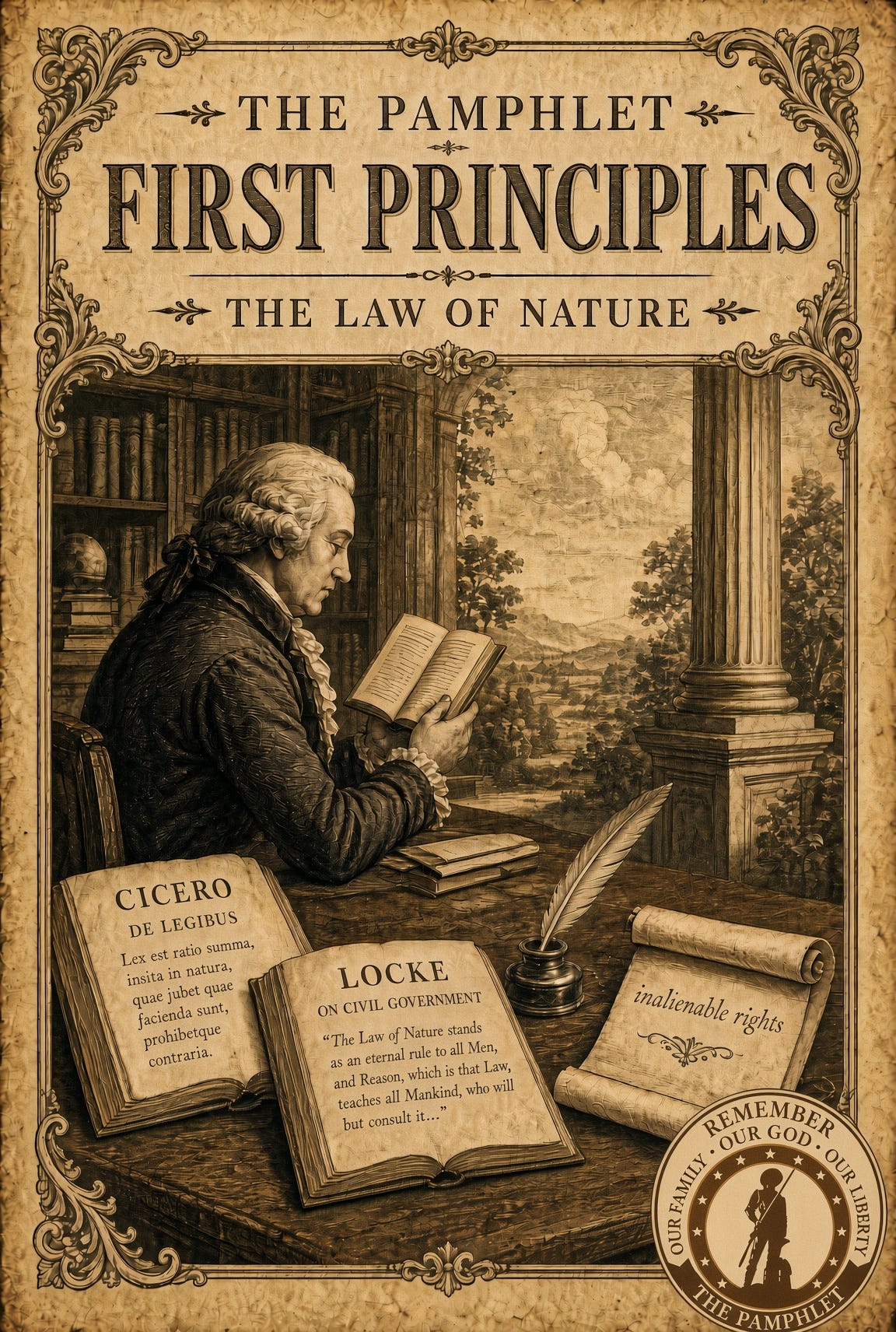
Cicero, in the Republic, put the oldest line in one sentence. True law is right reason in agreement with nature. It is of universal application, unchanging and everlasting. It summons to duty by its own commands and averts from wrongdoing by its prohibitions. It is a sin to try to alter it, nor is it allowable to attempt to repeal any part of it, and it is impossible to abolish it entirely. We cannot be freed from its obligations by senate or people. There will not be different laws in Rome and in Athens, or different laws now and in the future, but one eternal and unchangeable law will be valid for all nations and all times. Anything that is in addition to the law is not law and is unjust and that which is unjust should not be followed. There will be one master and ruler, that is, God, over us all, for he is the author of this law, its promulgator, and its enforcing judge. He who does not obey it flies from himself and does violence to the very nature of humanity.
True law is right reason in agreement with nature… one eternal and unchangeable law will be valid for all nations and all times, and there will be one master and ruler, that is, God, over us all.
That is the law of nature. It is not a statute. It is the rule reason finds when it looks at what man is before government is even a contemplation. Cicero was just one of many who wrote of the law of nations. The Romans used the phrase for the rules that reason established among all mankind and that all peoples observed, as distinct from the civil law that each people made for itself. If was wrong for one to take from another, to force himself or his will upon another, and each had a right to defend their life and their inherent rights. There are general things which humanity in their natural state consider to be violations of the norm or what is permissible. Later writers separated the two laws more sharply. The law of nature binds every person. The law of nations is that same natural rule applied to the dealings of nations and peoples with one another. One man is an island of his natural rights and two men on an island are a nation based on mutual respect. During the formative years of our nation, they still used both phrases. In each case it meant the fence that stood in place before any government was hired, and the same fence still applies when one people deals with another. We don’t have the right to tell our neighbors how to live their lives and they don’t have the right to tell us how to live our lives, yet collectively we each enjoy freedom to enjoy our lives so long as we don’t impose on others.
Locke took the same ground in his Second Treatise. To understand political power right, he wrote, we must consider what state all men are naturally in. I often turn readers to a thought of a castaway like Robinson Cruesoe who found himself upon an island and in that state of perfect freedom. That natural state is a state of perfect freedom where one can order their actions and dispose of their possessions and persons as they think fit, within the bounds of the law of nature, without asking leave or depending upon the will of any other man. The state of nature has a law of nature to govern it, which obliges everyone. A person has the right to engage in commerce from a passing merchant ship or defend what they have against piracy by any means necessary. In addition to that reason, the law teaches all mankind who will but consult it, that being all equal and independent, no one ought to harm another in his life, health, liberty, or possessions. Men are the workmanship of one omnipotent and infinitely wise Maker. All the servants of one sovereign Master, sent into the world by his order and about his business. They are his property, whose workmanship they are, made to last during his pleasure, not one another’s. Everyone is bound to preserve himself, and by the like reason, when his own preservation comes not in competition, ought he as much as he can to preserve the rest of mankind.
The state of nature has a law of nature to govern it… being all equal and independent, no one ought to harm another in his life, health, liberty, or possessions.
Locke is careful to let his readers know that freedom is not a license that must be obtained. The law of nature is already there. No man may destroy himself, and no man may harm another in life, health, liberty, or possessions. The execution of that law, in the state of nature, is the power inherent in every man’s hand, so that the innocent may be preserved and offenders restrained. When men enter civil society, and contract with one another to live under a banner, they give up a portion of that executive power to the public, on the condition that it will be used for the preservation of their property, which Locke means as life, liberty, and possessions. The power the magistrate holds is not a new power invented by legislature or an executive order. It is the power the people already had under the law of nature, handed over for a time, and still limited by the same law. If the hired stewards use it for any other purpose, the charge has failed and the people reserve the right of nullification. That is, they reserve the right to rescind the power that was given away so that they can assert their rights under the Natural Law which is supreme. That is the law under which our Declaration of Independence and our States Declaration of Rights was issued.
That is the background and context that the people understood during our Nations formative years. Writers like Thomas Paine called it “Common Sense”. The Virginia Declaration of Rights opens with the rights that pertain to the people and their posterity as the basis and foundation of government. All men are by nature equally free and independent and have certain inherent rights, of which, when they enter into a state of society, they cannot by any compact deprive or divest their posterity. Among these are the enjoyment of life and liberty, with the means of acquiring and possessing property, and pursuing and obtaining happiness and safety. The Declaration of Independence says the same thing in the language of 1776. We hold these truths to be self-evident, that all men are created equal, that they are endowed by their Creator with certain unalienable rights. The Creator is the author and creator of our independence. The rights are not granted by the legislature. They are the law of nature written down so that no one can pretend he does not know them.
The thing to remember about the law of nations is the same boundaries when one people deal with another. It is not a treaty, but something already inherently there. A divine law of how we should treat each other that we inherently understand. A treaty is a contract between nations. The law of nations is the natural rule that already binds the people to some basic realities. Among them do not harm another people in their life, liberty, or possessions; keep your faith and don’t impose upon another’s conscience; do not treat other people as if they were made for your use. The formative years appealed to it when they said the King had violated the law of nations by cutting off trade, transporting men beyond the seas to be tried, and waging war against his own subjects. They did not invent the appeal that they used, they boldly stood together as they used the language Cicero and Locke had already made common. Now ask yourself why those classics are not taught today while socialism and other forms of slavery are becoming popular.
Now let’s consider this next to the last three articles I have written. Consent is the hire of a temporary steward who is trusted with some of our power that we have loaned out. The trustee does not become the owner, nor can they invent new powers and authority. Mason refused the hire in public when the new framework for the constitution left the fence unwritten. He knew that what was common sense back then, might be an unknown history in the future. The Packet of newspapers from the 19th of September 1787 put the text in the street, and the people still had to decide. The law of nature and the law of nations are the reasons that the decision matters. The people decided to loan some of their authority to create a new government. A legislature that claims the power to redefine life, liberty, or property has already stepped over the fence and is a form of tyranny. A movement that recognizes that tyranny claims a private election or a self-declared officer as the civil authority has done the same. And for those that are devout and claim that their movement is of Divine origin consider that when weighed against inalienable rights, a sincere belief that God cares about liberty does not make any private election, jural society, or self-declared officer the civil authority. People still must consent or there is no validity of any politician or one claiming original authority. The law of nature does not require a self-declared movement or a single man to finish what the Creator began. It requires that the fence be kept, and that the hired stewards be fired when they fail the charge.
Nature’s Law and the Law of Nations is the hallowed ground that our nation of liberty is founded upon. Cicero named it. Locke and Sidney named it again. The state declarations of rights named it. The Declaration of Independence named it. The newspapers of 1787–88 argued about whether the new framework had left it unsecured. The later schoolbooks treated the argument as settled. It is not settled, look at the state of our nation. The fence is still there waiting for people to wake and realize they are free. The question is whether people still know it, and whether they will use the ordinary means to keep it.
Wednesday, we go back to a man who lived the principle under fire.
Carry this into the week: The law of nature is already there. Does the choice of hireling you are offered this election keep the fence, or does that choice ask you to step over it for peace, safety, and convenience?
Wednesday: They Lived It — a man who lived the principle under fire.
If this article inspires you, become a paid subscriber. The Pamphlet Substack exists to fund our operations and keep the lights on. Printed copies and the coming volumes will be found at www.ThePamphlet.net.
Sources
Cicero, De Re Publica III.33 (true law is right reason in agreement with nature). Cicero, De Legibus (law as the highest reason implanted in nature). Locke, Second Treatise of Government, §§ 4–7, 87–89, 95 (state of nature, law of nature, entrance into civil society). Virginia Declaration of Rights, 12 June 1776. Declaration of Independence, 4 July 1776. Public-domain texts. Educational commentary only. Not legal advice.
Remember · Our Family · Our God · Our Liberty
Technology Use Disclaimer – THE PAMPHLET LLC
THE PAMPHLET LLC employs modern software, hardware, and tools of technology throughout our research and publishing process. These tools help us locate original historical documents and primary source material, organize research files, review drafts for clarity and consistency, catch errors in grammar and quotation, and flag passages that need additional research or may not read clearly to the average reader.
Some of the software we use in research and editing incorporates artificial intelligence capabilities. These capabilities assist us in scanning material, suggesting improvements, and checking consistency; they do not generate the underlying ideas, arguments, or narrative. The formulation of topics, selection of sources, creation of content, and final writing remain primarily human.
We also use these tools to carefully enhance, clean, and occasionally reimagine historical paintings, prints, lithographs, etchings, and similar artwork so readers can view the past with greater clarity. Creative liberties are kept to a minimum so the technology does not distract from the true historical story. We respect the original artists and the historical record.
In every case the tools of technology serve as assistants. The thinking, research direction, writing, editorial judgment, and finished work are the product of human authors and editors.