


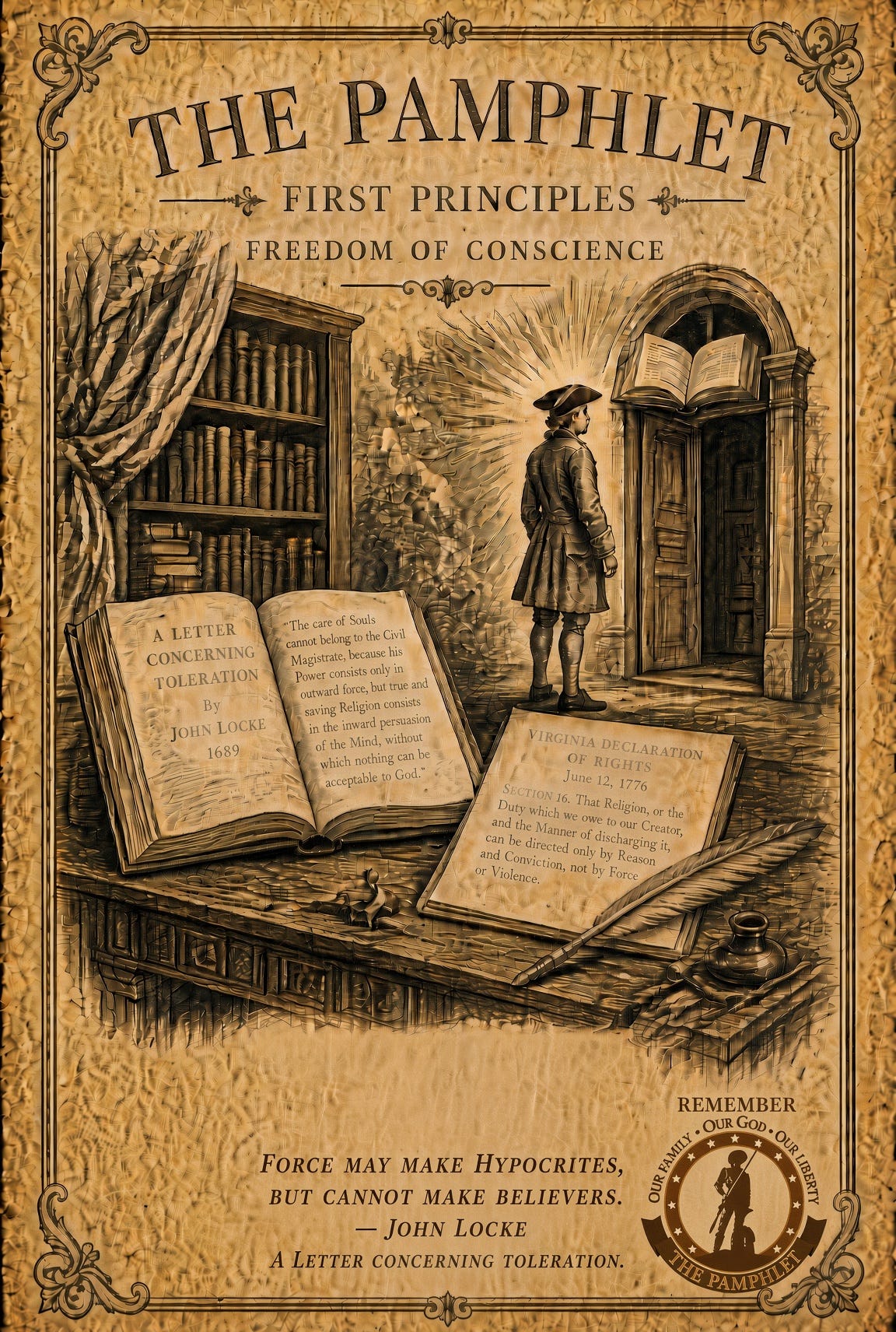
If Friday’s article left you with provocative thought that the Confederacy had won the war. Our Congress that received the word of the victory at Yorktown continued on under the Articles of Confederation and Perpetual union for years and only after a bitter fight over inalienable rights. The government that won the war was the one already in place. The boundaries that the people had established to declare and protect their rights were still there. Today we go back to one of the rights that our Founding Fathers vehemently protected: freedom of conscience. John Locke identified it in much of his work, although it stands out most in his A Letter Concerning Toleration that he wrote in 1689. He wrote it for Phillipp van Limborch, a Dutch theologian that Locke was writing to while in exile in the Dutch Republic. The Virginia Declaration of Rights also captured it eloquently as did other states’ Declaration of Rights. The people who hired their delegates to congress as stewards under the Articles of Confederation already knew it.
Now let’s look into that Letter Concerning Toleration that Locke wrote. He begins by explaining that religious tolerance is the mark of the true church. “Toleration of those that differ from others in matters of religion is so agreeable to the Gospel of Jesus Christ and to the genuine reason of mankind that it seems monstrous for men to be so blind as not to perceive the necessity and advantage of it.” Here he is careful to also explain that the care of souls is not committed to the civil magistrate. “God has never given any such authority to one man over another as to compel any one to his religion. No man can so far abandon the care of his own salvation as to leave it to the choice of any other, whether prince or subject, to prescribe what faith or worship he shall embrace. For no man can, if he would, transfer his faith to the dictates of another.” Faith is not faith without believing. Lock explains this boundary in a commonsense way. If God himself has not given you the authority and inherent power to force your religious views upon another conscience and dictated what it must believe and feel then that power cannot be vested unto a government, military, or to anyone else as it never existed in the first place. For those who turn to force, Locke has an answer for that.
Locke is clear on what force can and cannot do and it can never produce belief no matter how many times a person is flogged or how many bombs drop upon a nation. “No way whatsoever that I shall walk in against the dictates of my conscience will ever bring me to the mansions of the blessed. I may grow rich by an art that I take not delight in. I may be cured of some disease by remedies that I have not faith in. But I cannot be saved by a religion that I distrust and by a worship that I abhor. In vain do princes compel their subjects to come into their church communion under pretence of saving their souls. If they believe, they will come of their own accord. If they believe not, their coming will nothing avail them. When all is done, they must be left to their own consciences.” A church, he says, is a voluntary society of men joining themselves together of their own accord in order to the public worshipping of God. Nobody is born a member of any church. The magistrate’s power extends not to the establishing of any articles of faith or forms of worship by the force of his laws. That is the second point I would like to make. There is more that is worth reading but for the sake of brevity let’s move to the rights of Virginians.
Before the Declaration of Independence was written, Virginia came up with their own red line in 1776. Section 16 of the Declaration of Rights, adopted nearly a month before the Declaration of Independence, on the 12th of June, says that religion, or the duty which we owe to our Creator, and the manner of discharging it, can be directed only by reason and conviction, not by force or violence. Therefore all men are equally entitled to the free exercise of religion, according to the dictates of conscience. And it is the mutual duty of all to practise Christian forbearance, love, and charity towards each other. George Mason, an expert in inalienable rights and natural law drafted it, while James Madison, a young delegate at the time, helped shape it into its final form by adding language that strengthened the free exercise according to the dictates of conscience. The people of Virginia put it in front of the government they were forming under the Articles of Confederation. Their rights came first and the purpose of the government was to secure those rights, not invent them. They did not leave the duty to the magistrate to decide; they understood that the duty is owed to the Creator and that force cannot discharge it. That is the third point that I would like to leave you with.
Algernon Sidney had already said the liberty of a people is the gift of God and nature. The same gift covers the conscience and each one of us is unique. The formative years of our nation did not treat religion as a tool of the state or a reason to invade another nation. They treated it as a duty that stands before any politician, magistrate, or government hire. Eleven out of the original thirteen states were founded upon declarations of rights as the cornerstone of their government. The states except South Carolina and Rhode Island that wrote declarations of rights put the free exercise according to the dictates of conscience in front of the government. They made a point to state that rights come first before government. They did not write that the magistrate decides what is true or that an emergency declaration makes an exception. They wrote that reason and conviction decide, and that force is forbidden. The Confederacy that received the news of Yorktown was a league of states that had already secured this right in their own boundaries and their own way of life. The victory in the war did not rewrite it. The Creator did not give man the power to compel belief whether that be Christian, Muslim, Federalist or Antifederalist.
Now let’s look at this against our own times. A legislature that claims the power to redefine life, liberty, or property has already stepped over the boundaries and is in violation of natural law. A movement that sees the overstep and answers with appointments, private elections, or a self-declared officers has done the same thing. Each claims authority that they do not possess. Some claim that God has ordained this republic or their version of a political movement and this somehow justifies their tyranny. The truth is that this is the same claim Locke, Sidney, and the Virginia Declaration refused to accept. Sincere belief does not make any private election, jural society, or self-declared officer the civil authority. It does not make a vote of the people a declaration from God that their leader can violate natural law. The people still must consent or any claim to power is null and void and that consent can be withdrawn at any time that the steward violates the contract they take up or fails to remain accountable to the promises and agreements made to the people they represent. The Almighty does not require a self-declared movement or a single man to finish what He began. The formative years worshipped together and separately. Some were Protestants, others where Quakers, there were also plenty of Deist or of rationalist influence, and others had little or no public religion at all. They disagreed on doctrine and none of them ever said our nation is founded on Judeo-Christian values. Certainly, they expressed that the Creator, the law of nature, and Christian forbearance are founding principles and essential to inalienable rights. Through those principles they produced the Declaration of Independence, the Articles of Confederation and Perpetual Union, and the individual state declarations of rights. They did not place an individual or a group in the position of unique revelation and instead warned us to guard against tyranny and power that has no foundation in natural law. This is your history that you were not taught. An ignorant and pacified people are easy to enslave and extort.
The law of nature is already there. Freedom of conscience is part of the inalienable rights that bind any politician or public hire. Locke named it, and Virginia wrote it and declared it before the rest of the nation picked up the charge. The people under the Articles of Confederation already held it in proper perspective and our current government is out of touch and out of bounds.
Carry this into the week: Does the steward you hired know that he cannot compel your conscience, or does he treat the power as if it included the duty you owe only to your Creator?
Wednesday: They Lived It — Patrick Henry “Suspicion is a Virtue”.
If this article inspires you, become a paid subscriber. The Pamphlet Substack exists to fund our operations and keep the lights on. Printed copies and the coming volumes will be found at www.ThePamphlet.net.
Sources
John Locke, A Letter Concerning Toleration (1689). Virginia Declaration of Rights, §16 (12 June 1776). Algernon Sidney, Discourses Concerning Government. Public-domain texts. Educational commentary only. Not legal advice. Not pastoral counsel.
Technology Use Disclaimer – THE PAMPHLET LLC
THE PAMPHLET LLC employs modern software, hardware, and tools of technology throughout our research and publishing process. These tools help us locate original historical documents and primary source material, organize research files, review drafts for clarity and consistency, catch errors in grammar and quotation, and flag passages that need additional research or may not read clearly to the average reader.
Some of the software we use in research and editing incorporates artificial intelligence capabilities. These capabilities assist us in scanning material, suggesting improvements, and checking consistency; they do not generate the underlying ideas, arguments, or narrative. The formulation of topics, selection of sources, creation of content, and final writing remain primarily human.
We also use these tools to carefully enhance, clean, and occasionally reimagine historical paintings, prints, lithographs, etchings, and similar artwork so readers can view the past with greater clarity. Creative liberties are kept to a minimum so the technology does not distract from the true historical story. We respect the original artists and the historical record.
In every case the tools of technology serve as assistants. The thinking, research direction, writing, editorial judgment, and finished work are the product of human authors and editors.