


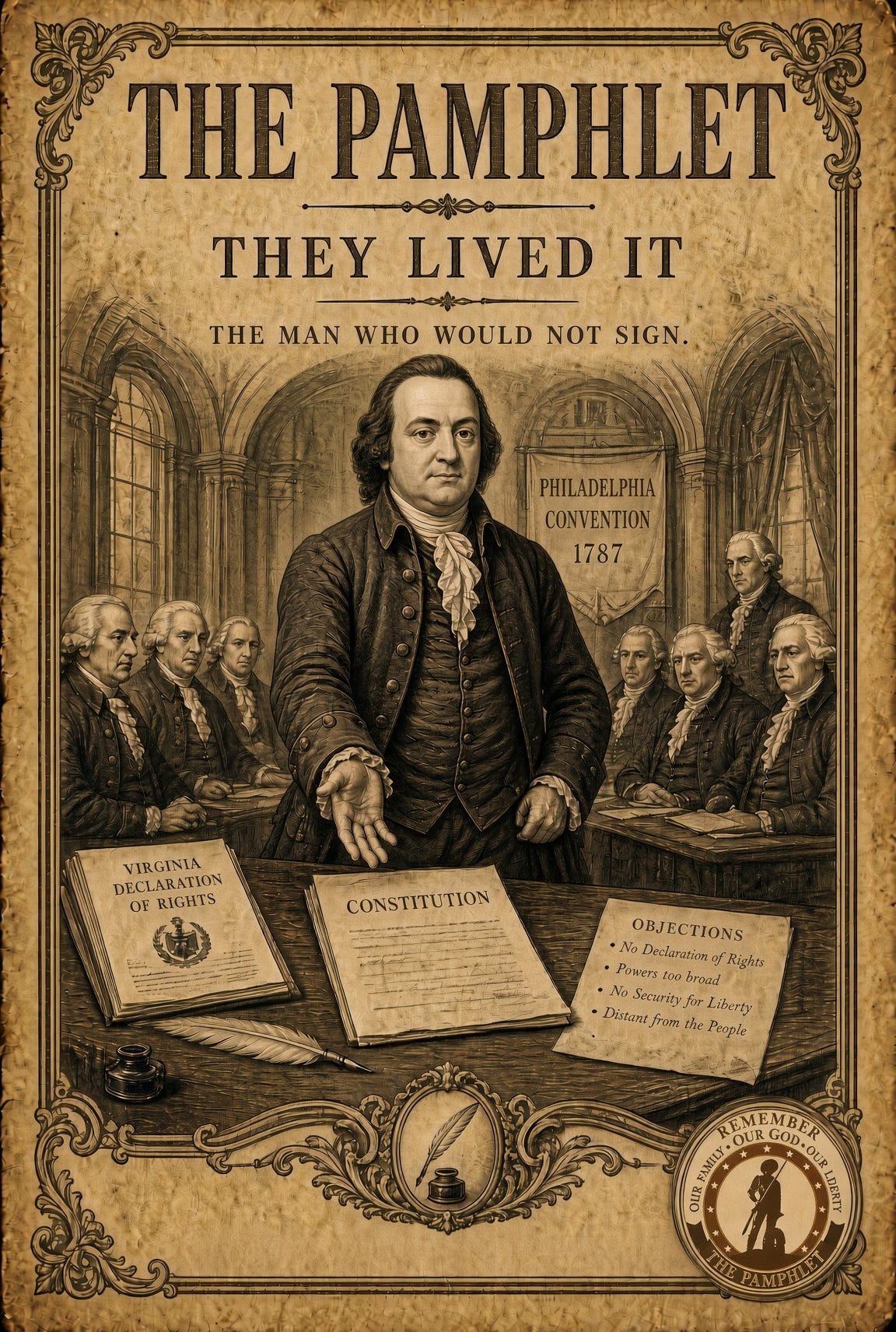
We explained on Monday that consent of the governed means we hire public servants as temporary stewards, not masters who tell us what to do. We also reminded you that you can fire those you hired when they fail to respect the boundaries of inalienable rights. Today we turn to a man who put those principles into action in public, on the record, without claiming privilege from his office or special revelation. His name is George Mason of Fairfax County, Virginia. He wrote the Virginia Declaration of Rights in June of 1776. Through the record we know that Mason knew inalienable rights better than most, and many Founding Fathers turned to him for deeper understanding of liberty. His passion for those rights only grew through the Revolution, and eleven years later he sat in the Philadelphia Convention and watched how delegates were caught off guard with the proposal for a new government. Instead of modifying the old one, it was argued that it would be easier to abandon the early confederacy and reform into a Republic. To many of the day the move to a republic disregarded history and what happened to the British government after the people had secured rights and then lost them. Some in Congress wanted it to be easier for the federal government to operate and argued that everyone knew what inalienable rights were and that they did not need to be in the new constitution. Mason watched the new framework take shape. Ultimately, he refused to put his name on it despite the pressure. Before we get his refusal to sign, one short word on the man, because some will tell you not to listen to him at all.
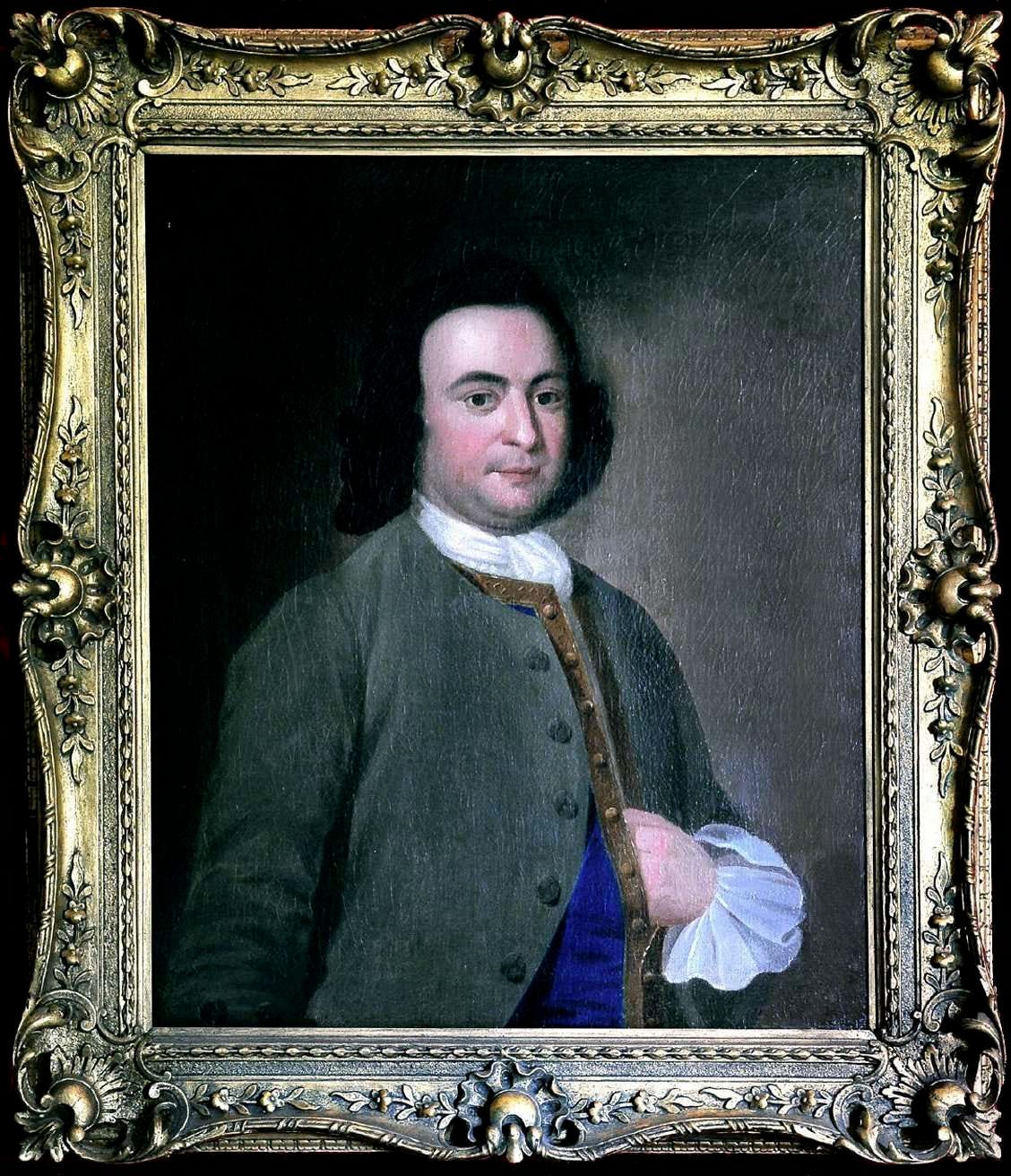
Mason owned a working tobacco plantation at Gunston Hall on the Potomac. By the 1780s roughly a hundred enslaved people lived and worked on the house and the four quarters. Over his lifetime he held at least three hundred. He inherited about thirty-five from his father. Others came with his wife’s portion, by gift, and by purchase. He was likely the second-largest enslaver in Fairfax County after George Washington. His 1792 will names thirty-six people and their increase as property to be divided among his children. It frees none even though Virginia law allowed the freeing of slaves, called manumission after 1782. He did not free his slaves even though he also spoke against the trade in public. At the Convention on 22 August 1787 he called it an infernal traffic and said every master of slaves is born a petty tyrant. In the Virginia convention the next year he called the trade diabolical and disgraceful to mankind, and said he would not admit the southern states unless they agreed to stop it. He wanted the trade ended. He treated the people already at Gunston Hall as property he could list in a will. That is the paradox in the record. It is real. It does not erase the rights of people and boundaries of government he wrote about, and it does not erase the refusal to endorse or sign on to the Constitution. This is an example that a man can see a poison and still pass the cup. You do not throw out the fence because the man who built it hopped over it. Perhaps the reason he spoke up so much about it was because he realized that it entrapped the slave owner and it entrapped the slaves. You read the line, and you read the failure, and you keep both.
Now on to the refusal. Mason went to Philadelphia in 1787 as a Virginia delegate. He participated through the summer and sat through the sweltering heat with the rest of them. He supported a stronger frame than the Articles of Confederation, but he insisted on a bill of rights and on structural limits that would keep the states from being swallowed. When the convention refused the bill of rights and adopted the supremacy clause as written, he would not sign. He was one of three delegates who stayed to the end and would not put their names down on the Constitution that ended our first government that was founded on rights. Edmund Randolph of Virginia and Elbridge Gerry of Massachusetts were the other two. Mason did not storm out and declare himself an interim government or create an alternate government in waiting as some do nowadays. He wrote his objections clearly and sent them to the people of his state.
There is no Declaration of Rights; and the Laws of the general Government being paramount to the Laws & Constitutions of the several States, the Declarations of Rights in the separate States are no Security.
That is the first line of his letter, and it is the whole problem in one sentence. Virginia, Pennsylvania, Maryland, and the rest had already written their declarations of rights down as the foundation of everything that came after. Mason had written Virginia’s and understood that the new framework made its own laws supreme. Without a national boundary written in the same hand, the state sovereignty as well as the people could be walked around. He did not stop there. The House, he wrote, had not the substance but the shadow only of representation. Laws would be made by men little concerned in, and unacquainted with, their effects. The Senate could alter money bills and originate appropriations, though the senators were not the representatives of the people or amenable to them. Combined with their power over appointments, treaties, and impeachments, and they’re being a constant existing body, they would destroy any balance and enable them to accomplish what usurpations they pleased. The judiciary was so constructed as to absorb and destroy the judiciaries of several states, rendering law tedious, intricate, and expensive, and justice unattainable by a great part of the community. The President had no constitutional council. He would be directed by minions and favorites, or become a tool of the Senate, or a council would grow out of the principal officers of the departments (the worst and most dangerous of all ingredients for such a council in a free country). There was no declaration preserving the liberty of the press, the trial by jury in civil cases, or against the danger of standing armies in time of peace. Those are Mason’s words, written that autumn and printed for the citizens of Virginia.
He was not alone in the refusal. Elbridge Gerry predicted the frame would produce a monarchy or a corrupt, tyrannical aristocracy. Patrick Henry, in the Virginia ratifying convention, attacked the opening words that many hold dear to this day. What right had they to say, We, the people? Who authorized them to speak the language of We, the people, instead of We, the states? He went on to warn that a single executive, with command of the military, the treaty power, and the pardon, had the tools of a monarch. Richard Henry Lee opposed ratification as did Luther Martin of Maryland who left the convention early and published The Genuine Information. He warned that if a state had to resist oppression by the sword, the new government framework would call that treason and leave the states the choice of tame submission or the label of rebels. The anti-federalist Brutus, widely identified as Robert Yates of New York, argued that a large republic could not preserve liberty, that a standing army would be used to subvert the government that raised it, and that the judiciary would become supreme. Federal Farmer said one representative for thirty thousand was too few to know local circumstances, and that a two-year army appropriation was no real check once the army existed. Centinel, Samuel Bryan of Pennsylvania, said the checks and balances would obscure corruption rather than prevent it, and that the wealthy and ambitious had preyed on the Confederation’s weaknesses to aggrandize power. The common fears were the same: no bill of rights plus the supremacy clause, necessary-and-proper and general-welfare language as open doors, a distant House, a Senate not amenable, a judiciary that would swallow the state courts, a presidency that could become monarchical, standing armies in peacetime, and the claim that the convention had exceeded its commission to revise the Articles of Confederation and Perpetual Union that formed our original government.
On 7 October 1787 Mason wrote to Washington and enclosed the objections. A little moderation and temper at the end of the convention, he said, might have removed them. They were not numerous, though some of them were capital. He did not ask Washington to anoint him. He asked the people of Virginia to read the list and decide. That is the ordinary political means the formative years actually used. Conventions, ratifications, and public arguments. Mason had already written, in the Virginia Declaration he drafted in 1776, that all power is vested in and derived from the people, and that magistrates are their trustees and servants, and at all times amenable to them. When the public servants failed that charge, he refused it and clearly stated his objections. He did not invent a third government interim or governments in waiting of his own. His conscience told him the framework was incomplete, he refused to sign, and he turned the rest over to the people. His conscience did not make him the civil authority even though he understood what the people would be giving up with the new government. The people of Virginia ultimately still had to consent or refuse, and the fate of the people would rest in their own hands. A sincere belief that God cares about liberty does not make any private election, jural society, or self-declared officer the civil authority. The people still have to consent to the good and the bad decisions. Mason knew the difference. He simply wrote the objections and went home to argue them.
Now look back two hundred and fifty years and ask whether the fears of those men were founded or not. Some were. Some were partially met and some were overstated yet as time goes on we can see the original boundaries and fences being torn down with each subsequent administration. The missing bill of rights was the strongest and most successful argument, courts now only argue for those rights mentioned in the constitution and give no weight to the Declaration of Independence and the States Declarations of Rights let alone the inalienable rights that Locke and Sidney had championed. Madison and others had said a national bill was unnecessary and even dangerous, because an incomplete list might be read as exhaustive, that rings true today. The pressure from the close states forced the promise of amendments and the outcry and betrayal expressed by the people in the papers of the day ensured that The Bill of Rights was ratified in 1791 in order to get more states to sign on. Mason’s first objection to lists of rights was partially answered when some rights were agreed upon, though later than he wanted and not in the original framework and with an emphasis on rights first before government. The structural fears have more mixed results. The supremacy clause, the necessary-and-proper clause, and the general-welfare language have been read far too broadly by the judiciary, and this has allowed government to grow and accumulate power it does not have. The federal judiciary has become the final word on many questions that once belonged to state courts and State sovereignty continues to erode as the years go on and precedent has accumulated to where the average citizen is a criminal and does not even know it. Standing armies in peacetime have become normal and President’s bomb countries without the consent of congress. Representation grew more distant as the country grew in population and adopted political parties instead of remaining free from them. The presidency accumulated powers the 1787 text does not plainly grant. On those points the Anti-Federalists were not inventing dangers they practically saw the future. They were naming open doors that the people of the time would not consider going through but that in later practice politicians walked through simply because they were there.
Those who gave us this new government because it was easier and convenient were not right that reform of the Articles was impossible, or that any stronger framework must become a consolidated despotism. The Articles had real defects that needed to be resolved and could have been. Requisitions were issued that the states ignored, there was no reliable revenue. No effective commerce power and inflation because of script and paper based on no real asset was worthless in reality. There was no independent executive or judiciary for national purposes. Many who wanted reform, including Mason at the start of the summer, agreed the Confederation needed strengthening. The disagreement was whether the Philadelphia draft reformed the Articles or abandoned the design the states had built on their declarations of rights. Mason’s position was the second. He wanted the state boundaries kept secure and a national fence written in the same hand. When the convention gave a national government supremacy without those borders, he refused to support it. The bargain that followed was real and incomplete and as time would tell, lacking real protection or definition of inalienable rights. The close states ratified because they were promised amendments that in many cases never came. The word “expressly,” which had limited the Confederation, did not return in the Tenth Amendment. Direct taxes were not put back behind requisitions. The standing army limit that Massachusetts asked for was not written and as a result of a shallow and incomplete bill of rights later memory often treats the Bill of Rights as the completion of a consensus rather than a definition of inalienable rights that our Constitution desperately needed. The votes, the refusals to sign, and the two states that stayed out until amendments moved show a condition, not a consensus. Mason and the men who stood with him were right to insist that the original government (states founded on declarations of rights, joined under the Articles) should be reformed rather than quietly replaced. They were also right that a people who hand over their power temporarily to governmental stewards without writing it down again will spend the next centuries arguing about what rights they kept and who grants them. That argument is still open even though the truth is etched in the records of the past for those who care to do the research. The records they left are the right tool for it. We leave you with a sample of some newspapers of the day. You will see that many did not embrace the new government, some did, and others expressed alarm.
The Constitution was printed for the public on 19 September 1787. The Pennsylvania Packet carried the first public printing that day. Within days the newspapers were filled with both celebration and alarm. The record is not a single voice. It is a fight in print. Here is what the people themselves wrote.
Centinel (Samuel Bryan), Independent Gazetteer (Philadelphia), 5 October 1787, addressed “To the Freemen of Pennsylvania”:
Friends, Countrymen and Fellow Citizens, Permit one of yourselves to put you in mind of certain liberties and privileges secured to you by the constitution of this commonwealth… before you surrender these great and valuable privileges up forever.
He listed what the Pennsylvania constitution already secured: houses, papers, and possessions free from general warrants; freedom of speech and of publishing; trial by jury as a birth-right. Then:
Whether the trial by jury is to continue as your birth-right, the freemen of Pennsylvania, nay, of all America, are now called upon to declare.
Later in the same essay he warned against the “frenzy of enthusiasm” that had seized Philadelphia before a rational examination was possible and said the love of domination is generally in proportion to talents. In Centinel IV he went further: “The evil genius of darkness presided at its birth, it came forth under the veil of mystery.” The Independent Gazetteer printed the Centinel series. Other papers refused pieces that did not leave a name with the printer.
Philadelphiensis, Independent Gazetteer, 7 November 1787, wrote that friends of the new constitution should not talk so freely about the press, because once the government was established they might speak of a gallows or a dungeon for writers like the Old Whig or Centinel. He reported that persons had waited on Mrs. Oswald (the printer’s wife) to ask her not to publish pieces against the Constitution, and that some had withdrawn their subscriptions when she refused. He closed:
The independence of America, which God himself vouchsafed through his infinite mercy to confer upon us, must end in a curse, if this tyrannical government be suffered to be established.
The Pennsylvania minority (21 of the 23 who voted no in the state convention) published their Address and reasons of dissent after the 12 December 1787 ratification. It was reprinted widely and they wrote that they had been prohibited from taking questions on separate articles and reduced to adopting or rejecting the whole. They were not allowed to enter their reasons of dissent on the minutes. Then:
We entered on the examination of the proposed system of government, and found it to be such as we could not adopt, without, as we conceived, surrendering up your dearest rights.
They offered amendments that would have protected conscience, civil jury, and the rights of the accused in federal courts. The process complaint (that they could not amend, only accept or reject) was part of what the papers carried.
Brutus Junior, New-York Journal, 8 November 1787, answered the two arguments he heard most often in favor of the new framework: that the men who formed it were wise and had deliberated four months, so it must be perfect; and that if it were not received the country would fall into anarchy and a government would be imposed by force. He said some of his fellow citizens had been imposed upon by that reasoning.
Not every voice was alarm. A “Pennsylvania Mechanic,” Independent Gazetteer, 29 October 1787, wrote that he had been delighted with the struggle to establish the new government, and accused the antifederal writers of hiding their names because they were ashamed. He proposed that printers follow the Massachusetts Gazette and refuse pieces unless the author left his name (yes people even back then wanted to censor dissent). Federalist papers and Federalist essays (including the series that became The Federalist) argued that the Articles had failed, that a bill of rights was unnecessary because the new government had only delegated powers, and that delay risked dissolution. The enthusiasm Centinel complained of in Philadelphia was real and so was the dissent. Was this the story of our early governments that you were taught in school?
The people who wrote did not speak with one mind. Some treated the new constitution as the rescue of the Union and the men who made it as above ordinary examination. Others treated it as a replacement of the government they already had (the state constitutions and the Articles) without declarations of rights written in the same hand, and without a fair chance to amend it before they were asked to accept or reject the whole. The process complaints (secrecy in the convention, the all-or-nothing vote in Pennsylvania, pressure on printers) were printed alongside the structural complaints (no bill of rights, supremacy, distant representation, standing army, judiciary). Both sets of complaints are in the newspapers of the autumn and winter of 1787–88. That is the record the later memory and history books often flattens into a completion of a caretaker or temporary government and the rise of an ordained constitutional republic blessed by the Divine Creator and Ordained to reign supreme. That was not how it really was. That same conversation is worth having today. Are we better off? Are we more free? Would we be better off clear definitions of inalienable rights with lists of examples of those declared rights and a government bound to secure them?
This is longer than I wanted it to be but set this next to the Monday article we did about consent. Remember that the trustee does not become the owner. George Mason had helped write the early declarations and understood this better than many. When the national constitution offered a bureaucracy that left the boundaries unwritten and the states’ fences unsecured, he declined in public what he could not support. That is what firing the hired looks like when the hired has not yet taken the office. You do not need a secret assembly or a special revelation to do it. You need the record, the ordinary means, and the willingness to put your name on the refusal instead of on the document. Friday, we go back to the papers and the week the Constitution was printed for the people who still had to decide.
Carry this into the week: If the hire fails the charge, do you sign anyway, or do you write the objections and let the people decide?
Friday: This Day — the Constitution is printed, and the people still have to decide.
If this article inspires you, become a paid subscriber. The Pamphlet Substack exists to fund our operations and keep the lights on. Printed copies and the coming volumes will be found at www.ThePamphlet.net.
Sources
George Mason, Objections to the Constitution of Government formed by the Convention, October 1787.
Mason to Washington, 7 October 1787 (enclosing the Objections).
Virginia Declaration of Rights, 12 June 1776, §2.
Mason’s remarks on the slave trade, Constitutional Convention, 22 August 1787, and Virginia ratifying convention, 15 June 1788.
Mason’s will, 1792. Gunston Hall records on the number of people held and the absence of manumission.
First public printing of the Constitution, Pennsylvania Packet, 19 September 1787.
Centinel I (Samuel Bryan), Independent Gazetteer (Philadelphia), 5 October 1787; Centinel IV.
Philadelphiensis I, Independent Gazetteer, 7 November 1787.
Address and Reasons of Dissent of the Minority of the Convention of the State of Pennsylvania, dated Philadelphia, 12 December 1787; printed by E. Oswald; reprinted in the Pennsylvania Packet, 18 December 1787.
Brutus Junior, New-York Journal, 8 November 1787.
“A Pennsylvania Mechanic,” Independent Gazetteer, 29 October 1787.
Luther Martin, The Genuine Information, Maryland Gazette, late 1787–early 1788 (treason warning in the tenth number, 1 February 1788).
Brutus is widely identified as Robert Yates of New York; the identification is the common one, not a proven signature.
Public-domain texts. Educational commentary only. Not legal advice.
Remember · Our Family · Our God · Our Liberty
Technology Use Disclaimer – THE PAMPHLET LLC
THE PAMPHLET LLC employs modern software, hardware, and tools of technology throughout our research and publishing process. These tools help us locate original historical documents and primary source material, organize research files, review drafts for clarity and consistency, catch errors in grammar and quotation, and flag passages that need additional research or may not read clearly to the average reader.
Some of the software we use in research and editing incorporates artificial intelligence capabilities. These capabilities assist us in scanning material, suggesting improvements, and checking consistency; they do not generate the underlying ideas, arguments, or narrative. The formulation of topics, selection of sources, creation of content, and final writing remain primarily human.
We also use these tools to carefully enhance, clean, and occasionally reimagine historical paintings, prints, lithographs, etchings, and similar artwork so readers can view the past with greater clarity. Creative liberties are kept to a minimum so the technology does not distract from the true historical story. We respect the original artists and the historical record.
In every case the tools of technology serve as assistants. The thinking, research direction, writing, editorial judgment, and finished work are the product of human authors and editors.