


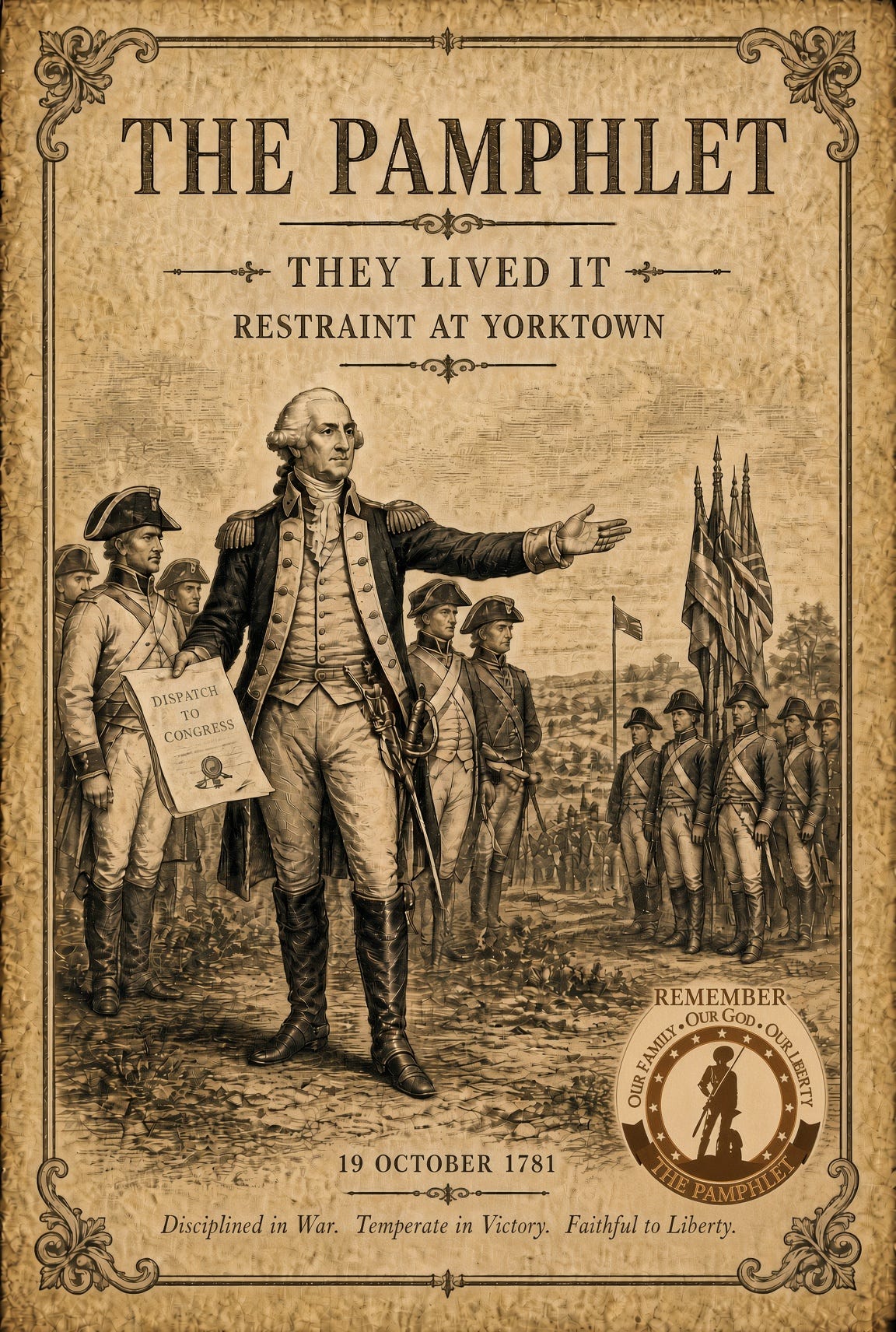
On Monday I explored the foundation of the law of nature as the boundaries that support our inalienable rights and that boundary that any public servant that we hire must respect. We have shown plenty of examples from the writings of Cicero and Locke. We further explained that Sidney had said that the liberty of a people is the gift of God and nature. We showed how the people wrote down their rights and how they expected government to be constrained. The Virginia Declaration and the Declaration of Independence were just some of the examples where they wrote it down so no one could pretend he did not know it. Today we go to a man who lived those principles or restraint and consent under fire, not as a speech but as a decision about power.
You know the siege by now; we have been writing about it for a few weeks on while giving you pieces to ponder along the way. The guns opened up on the on the 9th and the artillery and mortars pounded the fortifications. The fighting was fierce as the second parallel was fought through and opened up and many good men on both sides paid the ultimate price as the redoubts fell on the 14th. Cornwallis was out of options and bottled by the river and by de Grasse the French ally who would not let him leave. On the 17th a drummer beat the parley and a letter came from the British lines. Cornwallis proposed a cessation for twenty-four hours and commissioners to settle terms. Washington answered the same day. An ardent desire to spare the further effusion of blood would incline him to listen to terms that were admissible. He was willing to hear terms but not willing to allow for a long pause, he gave the British two hours to submit definite terms or the guns would open up again.
On the 18th Washington fixed the terms that he would accept. The British would be treated like they had treated the Americans. The garrisons of York and Gloucester, including the seamen, would be prisoners of war and they would not be sent home on parole. Adequate substance would be provided and they would be marched to places that could feed them, and the treatment that American prisoners of war had been observed to receive would be extended to them. Then the part that really mattered: the same honors will be granted to the surrendering army as were granted to the garrison of Charleston. At Charleston in 1780 the British had required the American garrison to march with colors cased. Laurens had been there. He would not grant the reverse. When a British officer called the article harsh, Laurens answered that the nation, not the man, was being considered. The commissioners met at the Moore house and the articles were settled. Cornwallis signed on the 19th. Whereas Washington, Rochambeau, and Barras signed it in the trenches where the battle had been won.
At two o’clock the British marched out. Colors cased. Shoulder arms. A British or German march. Cornwallis would not lead his procession of humiliation and did not come. He sent Brigadier General O’Hara. O’Hara offered the sword to Washington. Washington directed him to Major General Benjamin Lincoln, the American second-in-command who had been forced to surrender at Charleston the year before. Lincoln received the sword in the bittersweet moment and the arms were grounded. The men then returned to their camps to wait for the march to the prison camps in Virginia, Maryland, and Pennsylvania. Washington wrote Congress that evening from headquarters near York. A reduction of the British army under the command of Lord Cornwallis is most happily effected. He went on to thank Rochambeau and the French officers and named Laurens and the Viscount de Noailles as the commissioners. General Washington sent Tench Tilghman with the dispatch. The next day the orderly book carried the congratulations to the army. The general congratulates the army upon the glorious event of yesterday. He again thanked the French for their support and ordered the release of men in confinement so the general joy could pass through every breast. That is the record of what happened. Movies and books have been made to commemorate the moment, but most don’t consider the restraint that Washington exercised.
Now let’s ask what he did with the power that had been given to him. He held the combined force and the highest respect from the men who served under him. The French fleet held the gates, and the British army was prisoners. No one in that field could have or likely would have stopped him if he had decided the charge was over and the power was his. He did not and instead he demonstrated restraint that we all wish leaders and generals would show today and reported to Congress and to the representatives of the people. He asked for their approbation of the terms. The stoic general arranged the disposition of the troops under the orders he already had and then Washington wrote the ministers in Europe so they would have the news. George Washington decided not to kindle selfish desires and seize what he could have. He did not issue a proclamation that the people were now under a new master. He did not claim that the victory had made him the civil authority. The power he held was the power the people had already possessed under the law of nature, handed over for the preservation of their rights, and still limited by the same law. His actions demonstrated the principles of inalienable rights in action. When the military work was done, he began the arrangements to return the force to the ordinary charge without wasting a moment. That is power that knows how to stop.
You will hear later in other articles about Newburgh, when the officers talked of stronger measures and he put on his spectacles and told them he had grown gray and almost blind in their service and asked them not to open the door to civil war. It is worth mentioning briefly here. You will also read later about the resignation of the commission in December 1783, when he handed the power back in public and went home. Those days are not this day, but it is worth mentioning that George was consistent until the end. This day is the day after the guns stopped pounding holes in the ground and the British stacked their arms in surrender. The same man who had written that an ardent desire to spare the further effusion of blood inclined him to listen also wrote that the terms required the approbation of Congress. George Washington made sure that the fence was still there even though he had more opportunity than any to seize what did not belong to him. The hire was still a hire who looked forward to his retirement. The victory did not rewrite the law of nature; Washington put an explanation point after it.
Now consider for our own prosperity that a legislature that claims the power to redefine life, liberty, or property has already stepped over the fence that none has authority to remove. A movement that sees the overstep of our successive administrations and iterations of government and answers with a private election, appointment, or a self-declared officer has committed the same tyranny under another color. Washington did not seize power and instead became the standard that others should uphold. He used the power that had been given for the purpose it was given, and he reported the result to the body that had given it. The newspapers of the time carried the news the same way that they had carried the stories of Kings Mountain and the opening of the guns. Households that never saw York may have read that the British army had surrendered and that Washington had sent the word to Congress, but the story of restraint was lost to most. They did not read that a new sovereign had been declared on the field, or that one had an opportunity yet passed it up for the greater good.
The law of nature is already there and the power that is hired to protect it is still limited by it today as it was yesterday. On the 19th of October 1781 the man who held the greatest military power on the continent used it to finish the siege and then began the work of returning it to the people so he could go home and farm.
Friday, we go to the day the articles were signed and the guns of the war fell silent.
Carry this into the week: When the work is done, does the steward you hired know how to stop, or does he treat the power as if it had become his own? When stewards refuse to term limit themselves should we impose them?
Friday: This Day — Cornwallis surrenders, 19 October 1781.
If this article inspires you, become a paid subscriber. The Pamphlet Substack exists to fund our operations and keep the lights on. Printed copies and the coming volumes will be found at www.ThePamphlet.net.
Sources
Washington to Cornwallis, 17 and 18 October 1781 (terms of surrender; same honors as Charleston). Articles of Capitulation, 19 October 1781. Washington to the President of Congress, 19 October 1781. General Orders, 20 October 1781 (congratulations to the army). Orderly books of the siege. Public-domain texts. Educational commentary only. Not legal advice.
Technology Use Disclaimer – THE PAMPHLET LLC
THE PAMPHLET LLC employs modern software, hardware, and tools of technology throughout our research and publishing process. These tools help us locate original historical documents and primary source material, organize research files, review drafts for clarity and consistency, catch errors in grammar and quotation, and flag passages that need additional research or may not read clearly to the average reader.
Some of the software we use in research and editing incorporates artificial intelligence capabilities. These capabilities assist us in scanning material, suggesting improvements, and checking consistency; they do not generate the underlying ideas, arguments, or narrative. The formulation of topics, selection of sources, creation of content, and final writing remain primarily human.
We also use these tools to carefully enhance, clean, and occasionally reimagine historical paintings, prints, lithographs, etchings, and similar artwork so readers can view the past with greater clarity. Creative liberties are kept to a minimum so the technology does not distract from the true historical story. We respect the original artists and the historical record.
In every case the tools of technology serve as assistants. The thinking, research direction, writing, editorial judgment, and finished work are the product of human authors and editors.