


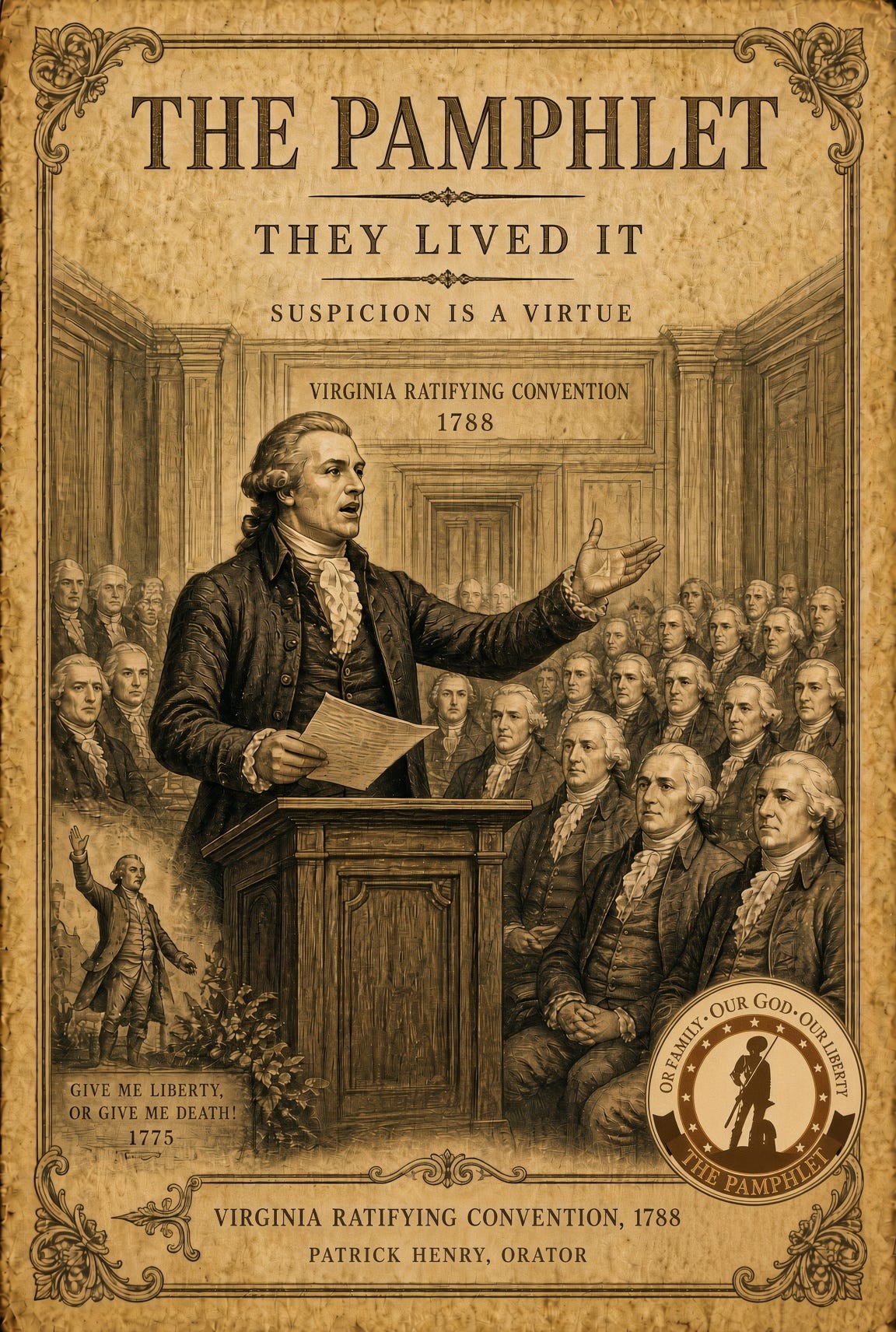
I hope that Monday’s article left you thinking more about freedom of conscience and how important it is to our inalienable rights. Welcome back to those who are returning and a heartfelt welcome to those who are new to our Substack. Our last article is worth reading if you’re interested in freedom of conscience or our inalienable rights. To summarize; John Locke and Algernon Sidney concisely named the rights that all of us are born with and have existed for all of humanity. The young state of Virginia enshrined those rights in section 16 of its Declaration of Rights. That declaration became a model for the other states under the government the people organized under the Articles of Confederation and Perpetual Union. Today we turn to a man who used his voice to keep in check the public servants sworn to represent the people. We are going to show that Patrick Henry did not treat speech as a performance. He treated it as the duty of a citizen who still held the rights and who still had the power to refuse to give ground to tyranny when the steward that the people had sent to represent them stepped over the fence.
You know the 1775 line. We have covered it throughout the years, but let us refresh your memory for those who have joined us recently. At St. John’s Church in Richmond he asked whether life was so dear or peace so sweet as to be purchased at the price of chains and slavery. He answered for himself with a cry that came from deep within his spirit. Give me liberty or give me death! Washington and Jefferson were in the room. That speech helped move Virginia toward raising a militia at a time when people were still hesitant to stand against the King. That is the line the books keep and tell often even though we have explained that it is not the whole man that we think you should know.
Readers who have followed The Pamphlet will remember we wrote the earlier record. In Volume 1, Issue 6
we introduced you to the 29 May 1765 speech in the Virginia House of Burgesses where Henry had offered the Stamp Act Resolves. The resolves were printed and circulated widely in the other colonies, and they became one of the earliest and strongest public statements that Parliament did not have the right to tax the colonies without their consent. Volume 4, Issue 5
of The Pamphlet carried the text of the four resolutions from the Journal of the House of Burgesses. When some cried treason he answered, “If this be treason, make the most of it.” We noted then that the same insistence on unalienable rights and the same duty to object when government infringes them still stand.
Our exploration into Patrick Henry’s influence on our early nation began early in Volume 1, Issue 2
where we wrote about the 23 March 1775 speech at length. We explained that Richmond then held about six hundred people. The only building large enough was Henrico Parish Church. The house was packed and the crowd outside strained to hear through the windows. Henry began in a calm, solemn, soft tone. He said he considered the question nothing less than one of freedom or slavery, and that if he kept back his opinions through fear of giving offence, he would consider himself guilty of treason toward his country and of disloyalty toward the majesty of heaven. The crowd started to hang on every word as he warned against the illusions of hope and the siren song that transforms men into beasts. He said he was willing to know the whole truth, to know the worst, and to provide for it. It was at this point then that his voice started to rise with each word. The war is actually begun. The next gale that sweeps from the north will bring the clash of resounding arms. Our brethren are already in the field. Why stand we here idle? Is life so dear, or peace so sweet, as to be purchased at the price of chains and slavery? Forbid it, Almighty God! I know not what course others may take; but as for me, give me liberty or give me death!
The convention sat in silence for several minutes after he finished. The result? Opponents folded and Virginia began the process to raise the militia. William Wirt later reconstructed the speech from accounts by Jefferson and others who were present. We pointed readers then to the full text at ThePamphlet.net. In Volume 2 Issue 6
we returned to the same speech when we wrote of liberty revivals, the moments when a person’s soul sings with liberty after a period of oppression.
We have shown that Patrick Henry was already suspicious of concentrated power in 1765. He stayed true to his principles and remained suspicious after the war. The oratory and frank speech from the soul was a check across the whole period, not a performance that began only when the Constitution was proposed.
In June 1788 he stood in the Virginia Ratifying Convention and spoke against the proposed Constitution. He had read the paper. He had listened to the arguments that a strong consolidated government was necessary. He answered with the line that belongs in this article and one that I want you to remember. Suspicion is a virtue as long as its object is the public good, and as long as it stays within proper bounds. Guard with jealous attention the public liberty. Suspect everyone who approaches that jewel. He did not stop there. Unfortunately, nothing will preserve it but downright force. Whenever you give up that force, you are inevitably ruined. He challenged the convention to show him the age and country where the rights and liberties of the people were placed on the sole chance of their rulers being good men without a consequent loss of liberty. Henry then told them that the language of America had been different when the American spirit was in its youth. Liberty, sir, was then the primary object. He warned that the new Constitution squinted toward monarchy. He asked who authorized the convention to speak the language of We the People instead of We the States. States, he said, are the characteristics and the soul of a confederation. Consider the implications of that in our own current state of affairs and the lack of restraint no matter who is in power. This is exactly why our Founding Fathers fought to ensure that we had a 2nd Amendment.
Volume 4 of The Pamphlet already carried another line from the same speech: “O sir, we should have fine times, indeed, if, to punish tyrants, it were only sufficient to assemble the people! Your arms, wherewith you could defend yourselves, are gone; and you have no longer an aristocratical, no longer a democratical spirit. Did you ever read of any revolution in a nation, brought about by the punishment of those in power, inflicted by those who had no power at all?” Volume 2 had already set his well-known line beside the arming line: the great object is that every man be armed. Everyone who is able might have a gun. That is what we discovered in the official record. The suspicion of power was consistent from the Stamp Act Resolves of 1765 through the church in Richmond in 1775 and through the convention in 1788. The voice tested the principles of stewardship each time. It did not claim a new office or invent authority where it did not exist.
Patrick Henry was not alone in his opposition to the Constitution. George Mason had already refused to sign and the Anti-Federalists in Virginia and elsewhere raised the same concerns about the proper role of government. Some of their concerns (reserved powers, trial by jury, no standing army by bare majority, and no tax until the states had first been asked) became a rallying cry for the people and threatened the ratification process until the Federalists agreed to a Bill of Rights. Henry’s oratory was the public voice of that check and often why he is identified as a champion of inalienable rights. He did not claim a new office, and he did not declare himself the civil authority. Instead he stood in the convention the people of Virginia had called and he used the freedom of speech that the people already possessed under the law of nature. He was there to declare that the people will always retain their rights and that the hire was still a hire. The power to consent or to refuse still belonged to the people regardless of what the Convention declared. When the convention ratified, it was by a narrow margin and with the demand for amendments still on the table. The suspicion had done its work, or at least as it could. It had forced the question into the open and one that we must continue to ask of government to this day. Are we getting the full picture and have they gone too far?
We return to the newspapers of the time that carried the debates the way they had carried the news of Yorktown. Households that never sat in Richmond read that Henry had warned against consolidation and had told them to guard the public liberty with jealous attention. They did not read that a new sovereign had been declared or that we should trust government. They read that Patrick Henry had used the voice that the law of nature had already given him to declare his conscience. The papers also showed that the vote was a close 89-79 and that the debate was spirited. We are starting to see the great importance of the 1st Amendment and that is oratory as a check on tyranny. It is not a performance nor a circus it is a duty to speak and do the right thing even while others say otherwise. This is the same principle we recently wrote about when General Washington reported to Congress immediately after he had beaten the British and began to return the power to those who had been vested power by the people. The steward who knows how to stop is still limited by the fence that the people established. The citizen who suspects the encroachment to jewel that is our natural rights is a shepherd guarding his flock in the night against the wolf and is still exercising their rights.
Now let’s take this teaching and set it next to our own times. Our legislatures that claim the power to redefine life, liberty, or property have already stepped over the fence. By refusing to enforce the boundaries against unchecked power they have abdicated their responsibilities. Any movement or group that sees the overstep and answers with a private election or a self-declared officer has done the same kind of tyranny upon the people. Some claim that God has ordained this republic or their movement because it is the truth, or because they can point to the corruption of our original government. These are the claims Henry’s suspicion was built to test. Sincere belief does not make any private election, jural society, or self-declared officer the civil authority, and might does not make right. The people still must consent, or any claim to authority is worthless. Henry did not place himself in the position of unique revelation. Like many of our Founding Fathers he studied the classics and became acquainted with Natural Law. He placed the public liberty in front of every politician and steward and told the people to suspect anyone who tampered with their rights. I hope this inoculates you from some of the propaganda out there.
I hope that we have demonstrated to you that the law of nature is already there. Suspicion of power that encroaches upon public liberty is part of the responsibility of every citizen to challenge those who they elect and keep them loyal to the Natural Rights of all. Patrick Henry did his duty and warned the people about what would happen in the Virginia convention, and the people under the Articles already held the right to refuse the charge. Ultimately, we know that the Federalists prevailed. But consider how different our lives would be today if we still had our first government and our states were founded upon the Declarations of our Rights.
Carry this into the week: Does the steward you hired know that suspicion of his power is a virtue when its object is the public good, or does he treat the voice that questions him as if it had become a threat? What does that say about our current state of affairs?
Friday: This Day — the day the people still had to decide about power.
If this article inspires you, become a paid subscriber. The Pamphlet Substack exists to fund our operations and keep the lights on. Printed copies and the coming volumes will be found at www.ThePamphlet.net.
Sources
Patrick Henry, speech in the Virginia Ratifying Convention, 5 June 1788 (Elliot’s Debates). Patrick Henry, “Give me liberty or give me death,” Second Virginia Convention, 23 March 1775. Virginia Declaration of Rights. Public-domain texts. Educational commentary only. Not legal advice.
Technology Use Disclaimer – THE PAMPHLET LLC
THE PAMPHLET LLC employs modern software, hardware, and tools of technology throughout our research and publishing process. These tools help us locate original historical documents and primary source material, organize research files, review drafts for clarity and consistency, catch errors in grammar and quotation, and flag passages that need additional research or may not read clearly to the average reader.
Some of the software we use in research and editing incorporates artificial intelligence capabilities. These capabilities assist us in scanning material, suggesting improvements, and checking consistency; they do not generate the underlying ideas, arguments, or narrative. The formulation of topics, selection of sources, creation of content, and final writing remain primarily human.
We also use these tools to carefully enhance, clean, and occasionally reimagine historical paintings, prints, lithographs, etchings, and similar artwork so readers can view the past with greater clarity. Creative liberties are kept to a minimum so the technology does not distract from the true historical story. We respect the original artists and the historical record.
In every case the tools of technology serve as assistants. The thinking, research direction, writing, editorial judgment, and finished work are the product of human authors and editors.