


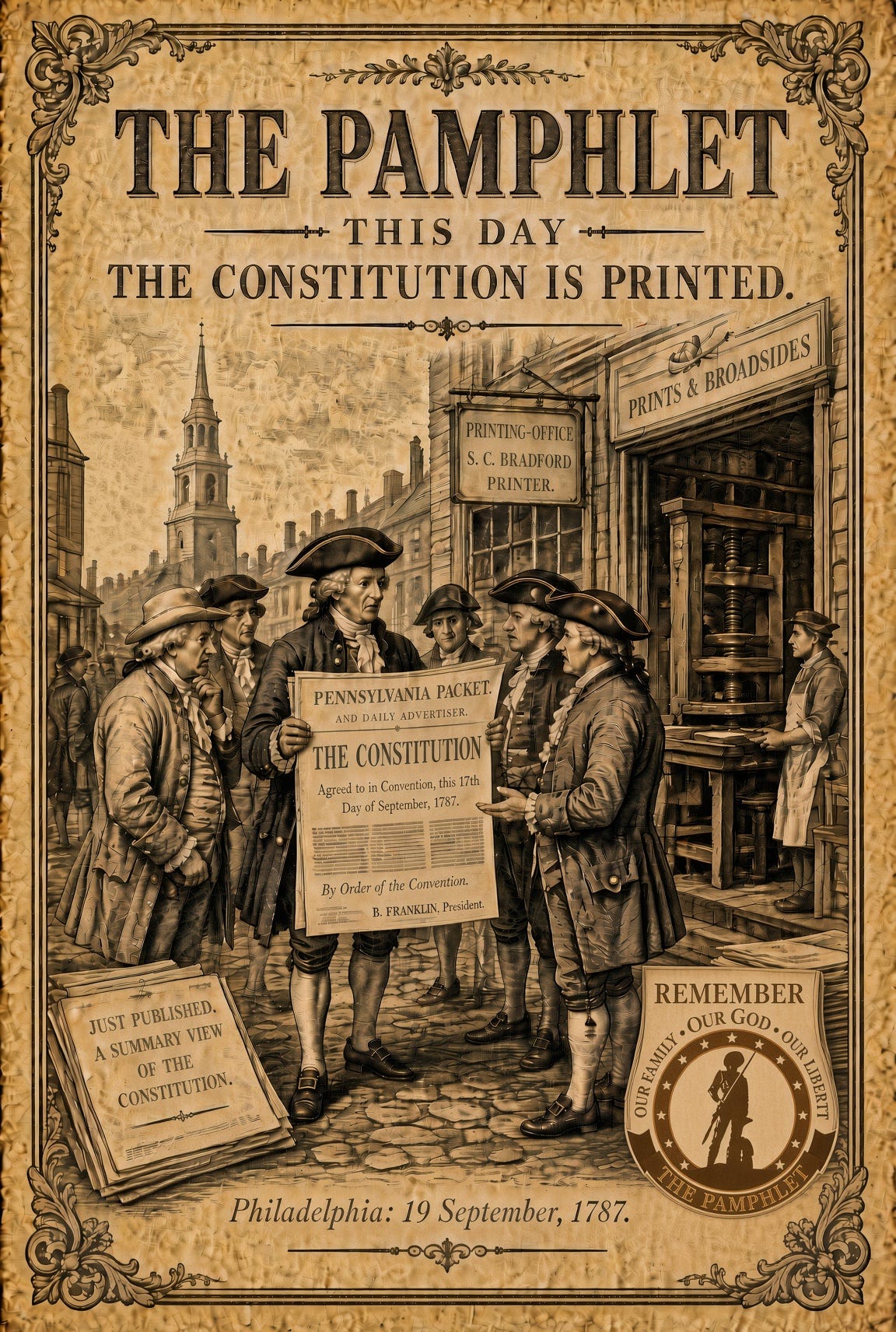
In our last article we discussed George Mason and the anti-federalist Founding Fathers objections to the new government and our Constitution. Today we go to the day the paper itself reached the people of America and examine the reactions in the weeks and months that came after. On the 17th of September 1787 the Philadelphia Convention finished its work and after a spirited debate, and thirty-eight men signed and started the process of dismantling the government that the revolution had given us. We have written about the fact that Mason, Randolph, and Gerry did not sign the draft constitution and how the story you heard was in fact different for the people that lived back then. We now turn to those other people who lived in our early nation and how they reacted to the news. That afternoon the printers John Dunlap and David Claypoole had received the final text. They had already printed the drafts for the convention through the summer and were well suited for the job. By the next morning, they had an official broadside printed and being distributed for New York. On the 19th of September their newspaper, the Pennsylvania Packet and Daily Advertiser, carried the first public printing of the Constitution. Four other Philadelphia papers printed a copy on the same day. The Packet is given primacy because Dunlap and Claypoole were the official printers for the convention. About twenty-five copies of their issue are known to survive.
The secrecy of the convention ended that week and the people that had put their faith in representatives to fix their government started to read for themselves what was proposed. On the morning of the 18th of September, the Constitution was read in the Pennsylvania Assembly. The pledge to not discuss the proceedings that the delegates had kept all summer was finished. Benjamin Franklin wrote to his sister Jane Mecom and informed her that she would see the Constitution in the papers. He explained that accommodating all the different interests and views had been a difficult task. He continued by noting that the different states might not ratify the Constitution with the same unanimous support the Convention had demonstrated when they sent it out for the people to consider. One line stood out to me. They had done their best, and it must take its chance. That is the line many free people wanted to hear. A new government would give the United States a chance at a path forward. The paper was not the decision; it was instead what the people had to decide on.
You will see the Constitution we have proposed in the Papers. … We have however done our best, and it must take its chance.
On the 20th of September William Jackson, the convention’s secretary, arrived in New York and the Constitution was read to the Confederation Congress. Congress set the 26th of September for its consideration. The debates were held in secret, but we can glean some things from surviving information. Melancton Smith’s notes are the best surviving record of what was said. The official journals show little of the political maneuvering. On 27 September Richard Henry Lee offered extensive amendments, including a bill of rights. Abraham Clark had noted that to enter Lee’s proposal on the journal would do injury. After studying George Mason and the early declarations of rights that the states made we can see how some may have been offended not to include extensive bills of rights. The record indicates that there was a fight inside Congress over the nature of the transmittal. There were some that wanted the Constitution sent to the states with congressional approval already attached, likely to get the people and legislatures to accept it more readily. Others in Congress wanted their opportunity to have their amendments attached before the people ever saw it as a finished transition. On the 28th of September the Confederation Congress compromised. They resolved “unanimously” that the Constitution, the letter, and the resolutions be sent to the states with only a suggestion that the states call conventions. None of the objections or dissent were included in the official record. The word “unanimously” gave the impression of approval and that everyone agreed. This is likely the version that most of us have heard. The approval was for the sending out the document, not an agreement on the framework. Even back then people with agendas told the narrative and truths that they wanted people to hear, while leaving out information to help make an informed decision.
That is the background from the week that the people of different states first held the paper in their hands. The convention had been called to revise the Articles of Confederation and Perpetual Union. What came out was a new type of government under a new framework. The resolution that accompanied it asked each state to call a convention of delegates chosen by the people, for their assent and ratification. If nine states would sign on to the change it would be enough to put it in force among those that ratified, if your state did not sign on and others did, you would be left out. The people still had their opinions and had to say yes or no but looking at history through a new lens we can see that politicians are not always up front with all the information that they needed to have to make an informed decision. Mason had already written that there was no Declaration of Rights, and that the laws of the general government being paramount, the declarations of rights in the separate states were no security, his words and other prominent Founding Fathers were already lining up on both sides of the argument. Centinel would soon ask the freemen of Pennsylvania whether the trial by jury was to continue as their birthright. The Pennsylvania minority would later say they could not adopt the system without surrendering up the people’s dearest rights. Consider that none of that had been decided on the 19th of September, there was no context and no presentation of both sides and positions. The Packet only put the plain text in the street and let the world know that the Congress had offered it up.
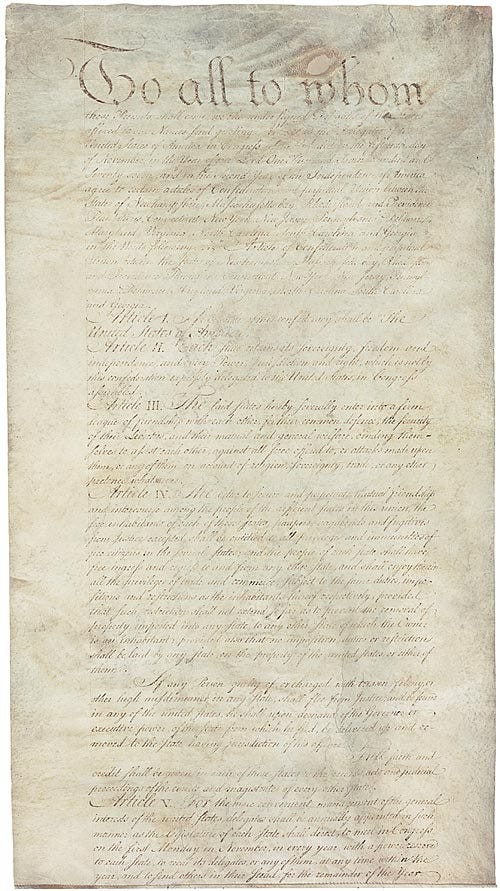
Later memory often treats the printing as the birth of an ordained republic, and you may be wondering why you have not heard the complete story before. Pre-Civil War schoolbooks did mention opposition to the Constitution, but they did not treat it as a serious, sustained argument that the Articles of Confederation should have been reformed rather than replaced. Noah Webster’s readers, Jedidiah Morse’s histories, William Grimshaw, Emma Willard, and the “Peter Parley” series presented the Articles as the country’s first government; adopted during the war. The Federalist arguments were generally presented more prominently and the ones we hear today. The government was deliberately weak after the break with a strong central power and limited by clear defects that most agreed on. There was no power to tax or regulate commerce, no independent executive or judiciary, requisitions the states could ignore, and only amendments with unanimous consent could be adopted. The 1787 Convention was presented as the remedy; George Washington presided, wise men who knew about these things met in secret, and the Constitution was the successful outcome. Opposition was acknowledged but only briefly. Patrick Henry, George Mason, and “some others” objecting mainly to the lack of a bill of rights or the strength of the new central government. History books gloss over the divide in the nation and formation of political parties that never existed by stating that our Founding Fathers quickly resolved by the promise of amendments and the ratification of the Bill of Rights in 1791.
The opposition that was discussed was treated as a useful correction that had been satisfied, not as a continuing claim that the original design had been abandoned. Those books did not dwell on, and in many cases did not report the newspaper contest (Centinel, Philadelphiensis, the Pennsylvania minority, Brutus), the process complaints (secrecy, the all-or-nothing vote in Pennsylvania), the close ratification votes (Massachusetts 187–168, Virginia 89–79, New York 30–27), or the structural fears (supremacy without a national definitions or declarations of rights, opposition to standing army, distant representation, a judiciary that could swallow the sovereignty of the states). Those arguments filled the papers prominently from 1787–88. This was not the emphasis in the schoolbooks that came out as the years followed. The ignorance of the details accelerated after the Civil War and again in the twentieth century. Once the Union had been preserved by force and the Constitution had become the symbol of national permanence, textbooks treated the founding as a consensus achievement ordained by our Divine Creator. The Articles became a brief, failed prologue, or as often described by historians today as a “caretaker government,” not meant to be permanent.
The Articles of Confederation and Perpetual Union became just the Articles of Confederation and eventually forgotten. The Anti-Federalists became a footnote that explained why we have a Bill of Rights. The close votes, the refusals to sign, and the argument that the states’ declarations of rights had been left unsecured largely dropped out of the ordinary classroom story. The Federalist papers are still taught but they leave out that the Anti-Federalist papers and how many of their arguments turned out to be right. The primary record never disappeared like Mason’s Objections, the Pennsylvania minority’s Address and Reasons of Dissent, Centinel’s essays, and the convention journals. They have been printed and reprinted, but later textbooks preferred the Federalist narrative of necessary improvement over the Anti-Federalist narrative of an incomplete bargain. In the books before 1860 the Articles were taught as the government the people had, along with the dates of adoption and ratification, and a clear place in the abbreviated sequence: independence, confederation for the war and the peace, discovery of defects in practice, then a convention called to revise it. It was a clean way to teach it and those interested could investigate more but it did a disservice to the arguments that could help people understand where our government went wrong. Modern textbooks usually compress that sequence into a short weak chapter between the Declaration and the Constitution, emphasizing failures such as Shays’ Rebellion as the reason a new frame was necessary. The Convention is presented less as a body that exceeded its commission to revise the Articles and more as the origin of the government Americans now have. We see that the result is that many readers meet the Constitution as the starting point rather than as the second framework and completely different type of government than the people had. If they read about it at all they meet the argument over whether the first government should have been reformed or abandoned as a surprise rather than as the central contest of 1787–88 that it was. The seeds of many rebellions were sewn in our early years at the convention. Consider that the next time someone wants you to get behind an article V convention to reform our constitution. You may get an entirely new government that you never wanted in the first place.
The papers of the weeks, months, and years after the new Constitution was presented to the people do not tell the same story as the history books. Some writers celebrated while others warned how it gave government too much power. Some printers were asked not to publish the warnings and others were threatened and caved into the censorship. The enthusiasm and the alarm were both real, and both were in print within days. The close states that later ratified did so on conditions and future promises that in many cases did not materialize. There was no consensus, there was anger, outrage, and the same type of ugly politics that we experience today. They were promised amendments but those promises were empty. The word “expressly,” which had limited the Confederation, did not return. The standing-army limit Massachusetts asked for was not written. The Bill of Rights came later in 1791, after public outcry and the pressure to return the principles that were outlined in previous states declarations of rights. The Bill of Rights was the watered-down compromise, and it came much later than Mason wanted. The printing of the Constitution on the 19th of September did not settle any of that, instead. It started the argument the people were entitled to have and that you likely never heard.
Set this article next to Monday and Wednesdays work and you have a more complete picture than you previously did. Consent is a hire of a steward and not a master. Mason refused the hire in public when it failed the charge and did his duty to inform the people of the danger of what was presented. The Packet of the 19th of September is the day the stewardship package was offered to the rest of the country, in reality it was their responsibility to do their own due diligence before they accepted. The people still had to consent, and they had the right to refuse. A right you still have today. A newspaper or history book that has been printed does not mean that the words and ink have been accepted by the people that lived it. Just as a sincere belief that the new framework was necessary does not make the printing itself with the consent of the governed. People still have to decide liberty or death. That is the line this week leaves you. Monday, we go back to the first principles and the freedom of conscience.
Carry this into the week: The paper is printed. Have you decided for yourself what it represents, or have you only been handed the text and half the story?
Monday: First Principles — Freedom of conscience (Locke’s Letter; Virginia Declaration §16).
If this article inspires you, become a paid subscriber. The Pamphlet Substack exists to fund our operations and keep the lights on. Printed copies and the coming volumes will be found at www.ThePamphlet.net.
Sources
Pennsylvania Packet and Daily Advertiser, 19 September 1787 (first public printing; Dunlap and Claypoole). Franklin to Jane Mecom, 20 September 1787. Resolution of the Federal Convention, 17 September 1787. Confederation Congress proceedings, 20–28 September 1787 (Jackson’s arrival and reading of 20 September; Melancton Smith’s notes of the debates of 26–27 September; Richard Henry Lee’s proposed amendments of 27 September; Abraham Clark’s remark in Smith’s notes that entering Lee’s motion on the journal would do injury; unanimous transmittal of 28 September without approbation). Public-domain texts. Educational commentary only. Not legal advice.
Remember · Our Family · Our God · Our Liberty
Technology Use Disclaimer – THE PAMPHLET LLC
THE PAMPHLET LLC employs modern software, hardware, and tools of technology throughout our research and publishing process. These tools help us locate original historical documents and primary source material, organize research files, review drafts for clarity and consistency, catch errors in grammar and quotation, and flag passages that need additional research or may not read clearly to the average reader.
Some of the software we use in research and editing incorporates artificial intelligence capabilities. These capabilities assist us in scanning material, suggesting improvements, and checking consistency; they do not generate the underlying ideas, arguments, or narrative. The formulation of topics, selection of sources, creation of content, and final writing remain primarily human.
We also use these tools to carefully enhance, clean, and occasionally reimagine historical paintings, prints, lithographs, etchings, and similar artwork so readers can view the past with greater clarity. Creative liberties are kept to a minimum so the technology does not distract from the true historical story. We respect the original artists and the historical record.
In every case the tools of technology serve as assistants. The thinking, research direction, writing, editorial judgment, and finished work are the product of human authors and editors.