


In my last article I left you with the thought of General Washington holding and being a good steward of the power he was loaned and then returning it back to the people. Today take a look at a few days after the day the history books write about. We previously discussed that the 19th of October 1781 was the day that the articles of surrender were signed and the British army marched out and grounded their arms. Friday the 23rd is the day we look at what the people under the Articles of Confederation and Perpetual Union were actually doing with the news. We were not a republic yet, in fact that was not a thought in the minds of the men we call our Founding Fathers. The mortars and cannons that opened on the 9th are silent. The title of this article is provocative for a reason. I mean to educate those who are unaware that our first government was a confederacy. The boundaries of government were still there. But the government that received the word of the great victory against the most powerful military on earth is still a Confederation with states founded upon declarations of rights.
If you read my previous article, you know the scene. On the 17th a drummer beat the parley and General Cornwallis asked for terms. Washington gave him two hours after the grim news of those terms was given to him. On the 18th the final terms were fixed: soldiers and sailors would become prisoners of war, not sent home on parole, and they would receive the same honors and treatment as the British gave Americans in Charleston. Laurens and the Viscount de Noailles met the British commissioners at the Moore house. On the 19th Washington had the articles copied in the morning and sent word that he expected them to be signed at eleven and the garrison to march at two. Both were done in accordance with the orders and at two o’clock the British marched, colors cased, shoulder arms, the British Army and the German mercenaries marched out and on to prison. Cornwallis did not come; the defeat must have been humiliating for him. General O’Hara offered the sword to Washington. Washington directed him to Lincoln, who had surrendered at Charleston under the same terms now returned to the British. The arms were grounded and the forces were taken into custody. Washington wrote Congress that evening from headquarters near York: a reduction of the British army under the command of Lord Cornwallis is most happily effected. He asked for their consent to ensure that he was passing the torch back to them now that the war had been won. He sent Tench Tilghman with the dispatch. That is the day the history books talk about.
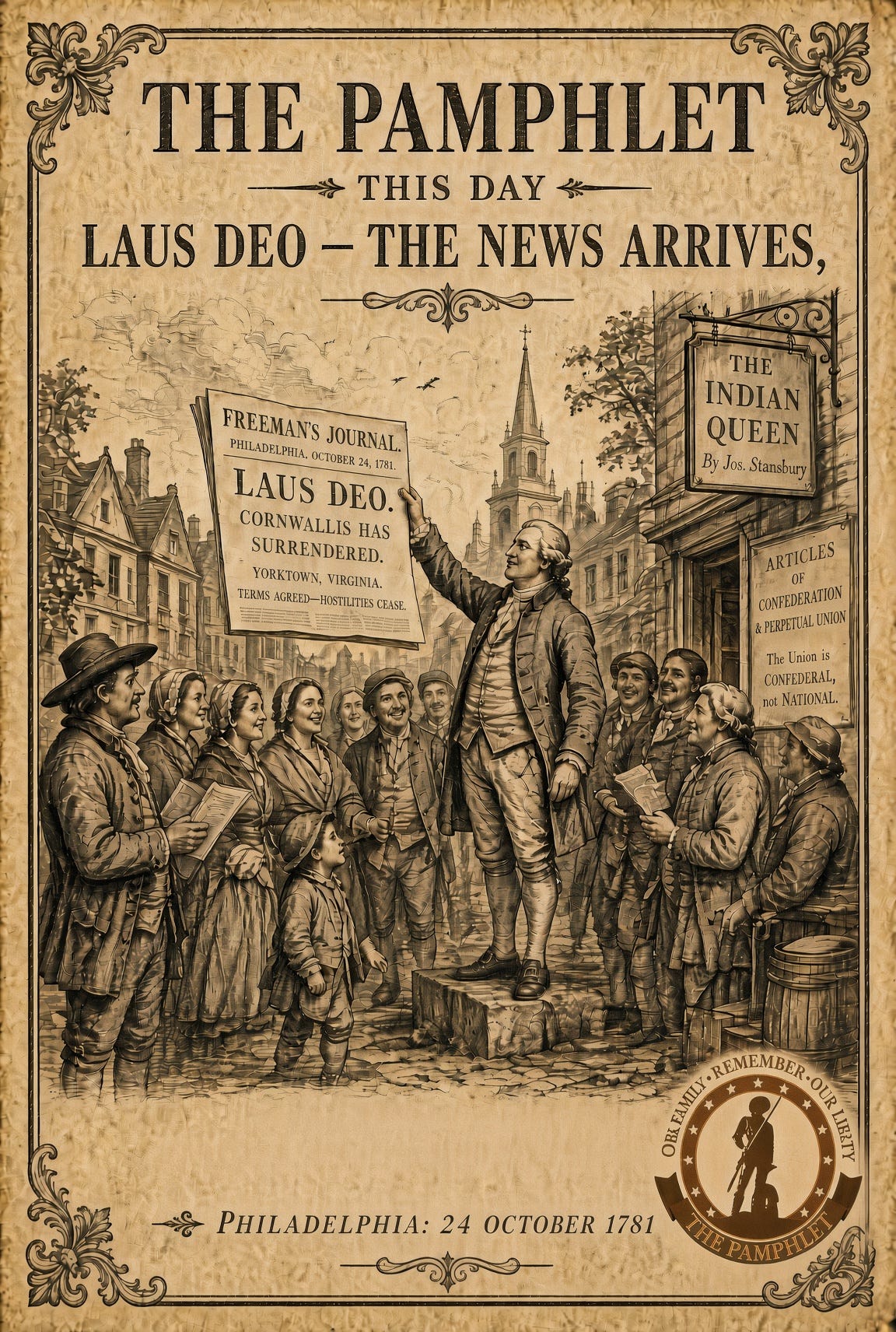
Now move forward a few days. The news had to travel and there was no internet, no phone, no telegraph, only riders and couriers carrying dispatches. Tilghman left by ship. He reached Philadelphia on the 24th of October. The Freeman’s Journal of that day printed the first announcement: on the 17th of October Lieut. Gen. Charles Earl Cornwallis, with above 5000 British troops, surrendered themselves prisoners of war. Then, in larger type, LAUS DEO. Praise be to God. The Pennsylvania Packet and the Pennsylvania Evening Post of the 25th carried Washington’s letter and the terms of surrender. Households that never saw the battle of Yorktown read the paper the same way they had read about the battle of Kings Mountain and the opening of the guns that defeated Cornwallis. A few concise lines could never really tell the whole tale, and they read that the British army had surrendered and that Washington had sent the word to Congress assembled under the Articles of Confederation. They did not read that a new sovereign had been declared on the field and this was well before the Presidency of the United States would ever be created in its current form.
In the army the methodical work continued although a sense of euphoria was in the air. On the 20th the orderly book carried the congratulations to the troops professionally without boasting. The general congratulates the army upon the glorious event of yesterday. He showed mercy and grace when he then ordered the men in confinement pardoned and released so the joy could pass through everyone that the bloodshed could stop. He ordered divine service the next day in the brigades and divisions, and he recommended that the troops attend with seriousness of deportment (attitude) and gratitude of heart for the interpositions (intervention) of Providence. As a former infantry soldier myself, I wonder how many soldiers today would understand that sentence. On the 21st the prisoners began their march toward Winchester and Fort Frederick. General Washington went to the fleet to thank Admiral de Grasse and to see if further cooperation was possible. On the 23rd word came back that the admiral would countenance and protect an expedition against Wilmington. Washington was already arranging the disposition of the troops: some to Greene in the south, some to return north with him to the Hudson. Hamilton wrote his wife on the 18th that tomorrow Cornwallis and his army are ours and that in two days he would set out for Albany. The men were packing up and sorting their affairs. The work was not finished, but the charge that had been given was being returned to the ordinary business of the fledgling Confederation.
Was it sudden? The people had lived with war for years and at times they likely could not see an end to it. The papers of the time do not show a nation that treated the news as a surprise that rewrote the government into a Republic. They show a people who had hired stewards under the Articles of Confederation and Perpetual Union, who had watched the siege from a distance, and who now read that the stewards had finished the work and were reporting the result to Congress. Moore’s Diary of the Revolution carries the later pieces: Cornwallis’s own letter of the 20th to Clinton, the congratulations of the 20th, and an address to Cornwallis that appeared in the Maryland Gazette. The tone is not the tone of a new master. It is the tone of a people who already held the rights and who had hired the power that had just been used and was returning to them. The victory did not rewrite the law of nature, nor did politicians suddenly take power. They did not replace the Articles that had formed their government and brought them this great victory. The papers and sources from the period confirmed that the hire had kept the pledge and returned the sword to the people when the job was finished.
Now contrast that with our own times. A legislature that claims the power to redefine life, liberty, or property has already stepped over the fence and onto the grounds of tyranny. A movement that sees that overstep and answers with a private election or a self-declared officer has done the same. On these days that formed our nation neither happened. The men who held the power used it to finish the siege and then began the arrangements to return it in an orderly manner. The papers of the time recorded the surrender under the government that already existed. They did not record a new sovereign or that the government did not have enough power. The Confederacy, the government under the Articles of Confederation and Perpetual Union, received the word, thanked the stewards who had preserved their rights, and continued on. That is the government that won the war and the history that you have likely not been taught.
The law of nature is already there, and it exists even today. The power hired to protect it is still limited by the constraints and only requires the people to have knowledge of these rights and the courage to act. On the 19th of October 1781 the articles were signed and the arms were grounded. By the 23rd the news was on the road, the prisoners were marching, the men were packing, and the people under the Articles were reading the paper.
Carry this into the week: When the work is finished, does the steward you hired know how to stop, or does he treat the power as if it had become his own?
Monday: First Principles — freedom of conscience.
If this article inspires you, become a paid subscriber. The Pamphlet Substack exists to fund our operations and keep the lights on. Printed copies and the coming volumes will be found at www.ThePamphlet.net.
Sources
Washington diary, 19–23 October 1781. Articles of Capitulation, 19 October 1781. Washington to the President of Congress, 19 October 1781. General Orders, 20 October 1781. Freeman’s Journal, 24 October 1781 (LAUS DEO). Pennsylvania Packet and Pennsylvania Evening Post, 25 October 1781. Frank Moore, Diary of the American Revolution, Vol. II (entries for 20–30 October 1781). St. George Tucker journal. Public-domain texts. Educational commentary only. Not legal advice.
Technology Use Disclaimer – THE PAMPHLET LLC
THE PAMPHLET LLC employs modern software, hardware, and tools of technology throughout our research and publishing process. These tools help us locate original historical documents and primary source material, organize research files, review drafts for clarity and consistency, catch errors in grammar and quotation, and flag passages that need additional research or may not read clearly to the average reader.
Some of the software we use in research and editing incorporates artificial intelligence capabilities. These capabilities assist us in scanning material, suggesting improvements, and checking consistency; they do not generate the underlying ideas, arguments, or narrative. The formulation of topics, selection of sources, creation of content, and final writing remain primarily human.
We also use these tools to carefully enhance, clean, and occasionally reimagine historical paintings, prints, lithographs, etchings, and similar artwork so readers can view the past with greater clarity. Creative liberties are kept to a minimum so the technology does not distract from the true historical story. We respect the original artists and the historical record.
In every case the tools of technology serve as assistants. The thinking, research direction, writing, editorial judgment, and finished work are the product of human authors and editors.