


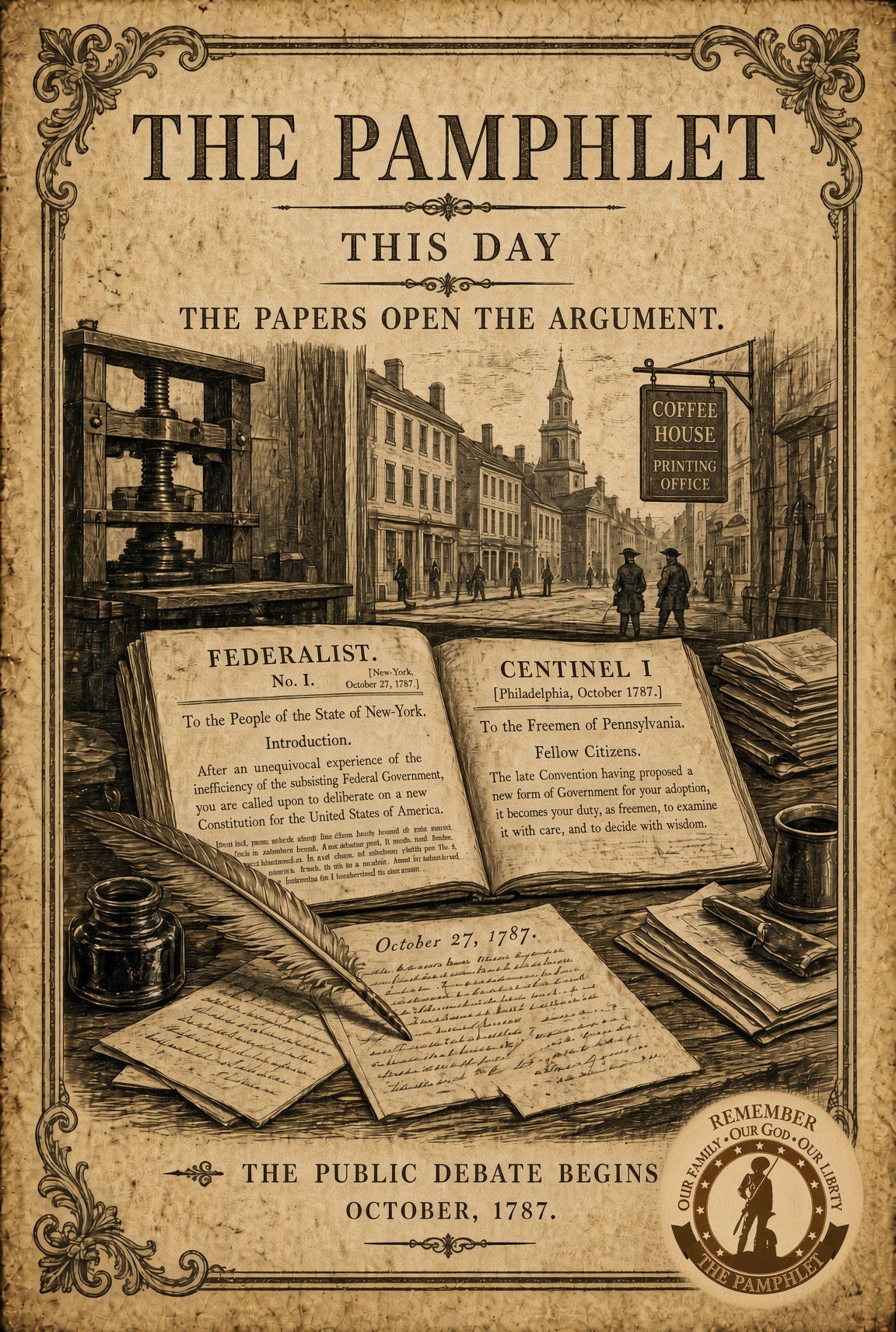
We recently discussed Patrick Henry’s suspicion of power and explained how it was considered a virtue to not trust government or power. He used free speech as a check on power and was a driving force with the Founding Fathers who wanted to remain under the Articles of Confederation and Perpetual Union where rights and the will of the people respected the boundaries of representation and loaned authority. In today’s article we go back a few months to the papers that opened the public argument. Many of our Founding Fathers wrote under pseudonyms to remain anonymous or to draw attention to the content not the author, most were identified later and we will note who made the argument when we are able. On the 5th of October in 1787 Centinel I (Samuel Brian, son of George Bryan the Pennsylvanian Supreme Court Justice and Constitutionalist leader) appeared in the Philadelphia Independent Gazetteer. On the 8th of October the Federal Farmer (generally attributed to Richard Henry Lee of Virginia but some historians suggest Melancton Smith) wrote a piece. Then on the 18th of October the rhetoric heated up as Brutus I (most commonly attributed to Robert Yates of New York a delegate to the Constitutional Convention who left early rather than endorse a new government) addressed the citizens of New York. On the 27th of October Federalist No. 1 appeared in the Independent Journal under the name Publius (attributed to James Hamilton). We are going to look at two sides of the one argument about power. The hire was still a hire whether they were a dogcatcher or President this was not the question. The fence and whether the boundaries should be moved was still the question.
Hamilton wrote Federalist No. 1 to the people of the State of New York. He recognized that a large portion of the population was skeptical of the new government and those who wanted their rights included were gaining ground. He reasoned that he would have to meet pen with pen if the new government were to have a chance to be ratified. Let’s review some highlights in his own voice. After an unequivocal experience of the inefficacy of the subsisting federal government, he said, “You are called upon to deliberate on a new Constitution. The subject speaks its own importance. It has been frequently remarked that it seems to have been reserved to the people of this country to decide the important question whether societies of men are really capable of establishing good government from reflection and choice, or whether they are forever destined to depend for their political constitutions on accident and force. He had to address multiple arguments from those in the country that did not like the idea of adopting a new government, especially some of the prominent Founding Fathers who had signed the Declaration of Independence. To remedy this, he proposed a series of papers.
The utility of the Union to your political prosperity. In the early papers (chiefly Jay and Hamilton) utilized fear tactics and told the people that without a new government war from abroad and within was surely coming. He argued that the Union was the only practical shield against foreign force and influence, against the wars that would break out among the states if they separated, and against the commercial and military weakness that would follow disunion. A divided America, they said, would invite the great powers of Europe and would turn the states against one another. The Union was not a convenience it was a matter of survival. He painted the picture that adopting a new government was the only condition of safety and of any lasting prosperity.
The insufficiency of the present Confederation to preserve that Union. Hamilton and Madison reviewed the record under the Articles of Confederation and Perpetual Union. In this paper they pointed out the deficiencies of our first government and painted the picture that the only way forward was to abandon the first government that was founded on the rights of the people and their individual states. Congress could requisition but could not compel the states to fund what the central government wanted. It could make treaties but could not enforce them on the states unless those states ratified the treaty. It had no reliable revenue as the people were suspicious of politicians who wanted to spend their money, no power to regulate commerce without the state’s agreement, and no effective judiciary. The result, they argued, was a government that looked federal on paper and was powerless in practice. They argued that the Confederation had already shown it could not keep the Union together or meet the ordinary demands of a nation but failed to mention that most states had sent their delegates to reform the government not create a new one.
The necessity of a government at least equally energetic with the one proposed to the attainment of this object. The papers that followed contended that the new Constitution supplied the energy the Articles of Confederation lacked: the power to tax, the power to raise and support armies and a navy, the power to regulate commerce, a national judiciary, and an executive that could carry the laws into effect. Energy, in their usage, meant the capacity to act. Without it, they said, the Union would dissolve or would survive only by the accident of good men and quiet times. Back then, like now, politicians played on the people’s fear of losing what they had. Framing the choice as a do or die decision swayed many people whose fear drove them to safety instead of preserving the liberty that they had just won.
The conformity of the proposed Constitution to the true principles of republican government. Madison’s papers, especially, argued that the new framework was still a republican form of government. It stated that it derived its powers from the people, and it divided those powers among branches. They claimed the new government would rely on representation rather than direct democracy over a large territory. The extended republic, Madison claimed, was more likely to control faction than a small one. They claimed that the Constitution did not abandon republican principles, it only applied them to a larger scale.
Hamilton tried to convince New Yorkers that it was similar to the existing state constitution and pointed New Yorkers to the similarities between the proposed national frame and the frames they already lived under in the states. The same separation of powers, the same reliance on representation, and the same reservation of rights not expressly granted. It was familiar because the new government was not a foreign invention. It was built on the same principles the states had already accepted only that same power would be held by the central government instead of exclusively by the individual states and the people that lived there.
Finally, Hamilton argued that the additional security which its adoption will afford the preservation of that species of government, to liberty, and to property. The closing papers argued that the Constitution would better secure republican government, individual liberty, and property than the Articles had done. A stronger Union, properly checked, would protect the states from one another and from foreign powers, and would protect the people from the instability that had already appeared under the Confederation. Properly checked were the key words which the whole thing would hang.
He said he would answer the objections that had already appeared and he did, but hindsight tells us that giving a central government more power was the start of the suppression of our inalienable rights. That Federalist opening leaned on fear and urgency. Power is necessary, they argued. The old framework is not enough power for the post war congress. They argued that a new government would secure the Union and liberty without addressing many key arguments of rights and state sovereignty.
The Anti-Federalist papers had already started to be circulated. Centinel I, published on the 5th of October 1787 in the Philadelphia Independent Gazetteer, was one of the earliest and most widely reprinted critiques of the proposed new government. It was addressed “To the Freemen of Pennsylvania.” The writer (later identified as Samuel Bryan) opened by reminding them of the liberties and privileges already secured to them by the constitution of their own commonwealth (Philadelphia’s Declarations of Rights were some of the strongest in the Union). He asked them to give serious attention to his opinion of the plan of federal government now submitted to their consideration, before they surrendered those great and valuable privileges up forever.
He told them the late Convention had submitted a plan for a new federal government. They should pay attention as the subject was highly interesting to their future welfare. Whether the plan was calculated to promote the great ends of civil society (the happiness and prosperity of the community) it behooved them to consider carefully, and to be uninfluenced by the authority of names. He warned that a frenzy of enthusiasm, not a rational investigation into its principles, had already actuated many of the citizens of Philadelphia in their approbation of the proposed plan. He pointed to the Pennsylvania constitution of 1776, which the people of that state had written under the Articles of Confederation, and which contained a Declaration of Rights and a structure that kept power close to the freemen. The new plan, he pointed out, departed from that security and gave too much authority away. It concentrated power into the hands of a few and it lacked a bill of rights to secure the inalienable rights that they had just won in a long war with the British. The new Constitution opened the door to a consolidated government that would render the state frameworks and their independence subordinate.
Centinel did not stop at general warnings. He questioned the motives and the methods of the Convention as he knew quite well that the delegates had been sent to reform the old government, not to scrap it altogether. He noted the high secrecy in which the convention convened, which resonated well with those who were rightfully suspicious of government and power. He argued as if he could see the future and explained that the proposed Constitution contained the seeds of a general government operating with unlimited powers, and that the people should not surrender the liberties they already held under their own state constitution without clear and express protections. The essay was blunt and brutally honest. It treated the proposed framework as a dangerous departure from the rights the freemen of Pennsylvania had already secured for themselves. It was reprinted in other papers and became one of the most circulated early Anti-Federalist statements. Centinel opened with the point that the liberties are already written. The question is whether the people will surrender them.
The late Convention had submitted a plan for a new federal government. Whether it would promote the great ends of civil society, the happiness and prosperity of the community, it behooved them to consider, uninfluenced by the authority of names that might support it. The Federal Farmer, a few days later, asked whether the proposed Constitution was the first important step toward one consolidated government. This resonated well with those that remembered the tyranny of the consolidated British government. He said the first important question was whether, considering their situation, they ought to precipitate the adoption. Brutus I, published on the 18th of October 1787 in the New-York Journal, put the question plainly to the people. The writer (most commonly attributed to Robert Yates) addressed the citizens of the State of New York. When the public is called to investigate and decide upon a question in which not only the present members of the community are deeply interested, but upon which the happiness and misery of generations yet unborn is in great measure suspended, the benevolent mind cannot help feeling itself peculiarly interested in the result. The most important question that was ever proposed to their decision, or to the decision of any people under heaven, was before them. What he was trying to say here was don’t think only of yourselves but consider those that will come after you.
He stated the choice without fluff or decoration. Whether the thirteen United States should be reduced to one great republic, governed by one legislature and under the direction of one executive and judicial, or whether they should continue thirteen confederated republics under the direction and control of a supreme federal head for certain defined national purposes only. It was clear that the new government was a reduction of what they had. That was the first question that was presented to the people. A confederated government, in his usage, kept the states as the primary bodies and limited the federal head to the objects the states had agreed to assign. A consolidated republic reduced the states to subordinate corporations under one general legislature, one executive, and one judiciary. He made it simple. Should the people and their individual states retain the power or should they entrust a strong central government.
Yates warned that a free republic cannot long subsist over a country of the great extent of these states. He appealed to the opinion of the greatest and wisest men who had ever thought or wrote on the science of government. He argued that those writers had held that a free republic required territory and a population small enough that the representatives could know the people and the people could know and watch the representatives. An extended territory, by contrast, produced a distant government, a standing army to enforce its laws, and a people too numerous and too scattered to maintain the manners and the vigilance a free government required. The proposed Constitution, he argued, was calculated to consolidate the thirteen states into one. The necessary-and-proper clause, the supremacy clause, the power of taxation, and the federal judiciary would draw the essential powers of the states into the general government. Once those powers were granted, the states would retain little more than the empty name of sovereignty.
If the new Constitution is calculated to consolidate the thirteen states into one, as it evidently is, it ought not to be adopted. Brutus did not claim the Articles of Confederation were perfect. He claimed that the remedy offered was the destruction of the confederated form itself. The people of New York, and of the other states, still held the right to refuse the new government and they ought to. The essay was the opening of a series that would continue into 1788, answering the Federalist papers as they appeared. That is how Brutus opened up the argument. The choice is between a confederacy of republics and one great republic. The extent of the country and the powers granted make the second choice fatal to free government and consequently to the liberties of the people.
These were the initial Anti-Federalist opening arguments. Power is the question that ought to be argued and in which hands it belongs. The old foundation that won the war was still there and issues could be worked through. Consolidation is the risk that the people should be weary of.
The newspapers carried both sides of the argument. If you take the time to read them now you will be surprised to see that fear tactics and false projections of a future that never happened that were used to form opinions. Households that never sat in Philadelphia or New York read that Publius had called them to deliberate on a new Constitution and that Centinel, the Federal Farmer, and Brutus had warned them not to surrender the liberties already secured under the state frameworks and the Articles of Confederation and Perpetual Union. They did not read that a new sovereign had been declared. They read two arguments about the same power and in whose hands it should reside. One said the government must be enlarged and power consolidated if the Union was to be preserved. The other said the enlargement itself was the danger and that the people should refuse the new Constitution until the declarations of rights were written back in the form of a bill of rights. That is the record we have discovered of these days. The papers did the work that Henry later did with his voice. They put the question in front of the people who still held the rights.
Readers who have followed The Pamphlet will remember we wrote in Volume 1 Issue 5 Perseverance
that the Anti-Federalists were right to oppose giving the federal government too much power, and that our first government was too weak while our second is too strong. In Volume 2 Issue 1 Tyranny
we noted that roughly half the Founding Fathers did not want to abandon the first Constitution out of fear of encroachment, and that the Bill of Rights was the partial check they forced. Their fears were recorded in the Anti-Federalist papers. Elbridge Gerry refused to sign for the same reason and later became a primary advocate for the Bill of Rights. Today we go back to the essays that opened that record in October 1787.
Now contrast that next to our own times. We have a federal legislature that claims the power to redefine life, liberty, or property and has already stepped over the Constitution meant to constrain it. State legislatures have forgotten their duty to the rights of the people they are supposed to safeguard, and courts do not recognize inalienable rights or any aspect of our first government as valid to current law. There are movements and organizations that see the overstep and answer with a private election or self-declared officers. That has done the same tyranny against the people. Charlatans use the claim that God has ordained this republic or their movement. While it is true that our current government is not what the Founding Fathers intended, the religious claim is the one both sides of the 1787 papers refused. Sincere belief does not make any private election, jural society, or self-declared officer the civil authority, nor does it grant unlimited power to those that are elected. The people still must consent. Publius and the Anti-Federalists did not place themselves in the position of unique revelation. They put the question of power in the papers and left it to the people. That is the inoculation from the lies of today that I wish to leave you with.
The law of nature is already there, and it will never go away. The argument about power is the same argument that Federalist No. 1 and the first Anti-Federalist essays opened it in the papers in October 1787. The people under the Articles still held the right to refuse the new government but did they choose peace and safety over liberty. Our Founding Fathers say that is a fool’s choice.
Carry this into the week: Does the steward you hired know that the power is still a hire, or does he treat the two papers (Federalist & Anti-Federalist) as if one of them had settled the question forever?
Monday: First Principles — the Right of Revolution as a last resort.
If this article inspires you, become a paid subscriber. The Pamphlet Substack exists to fund our operations and keep the lights on. Printed editions and the coming volumes will be found at www.ThePamphlet.net.
Sources
Alexander Hamilton, Federalist No. 1, Independent Journal, 27 October 1787. Centinel I, Philadelphia Independent Gazetteer, 5 October 1787. The Federal Farmer, early October 1787. Brutus I, New-York Journal, 18 October 1787. Public-domain texts. Educational commentary only. Not legal advice.
Technology Use Disclaimer – THE PAMPHLET LLC
THE PAMPHLET LLC employs various software, hardware, and tools of technology throughout our research and publishing process. These tools help us locate original historical documents and primary source material, organize research files, review drafts for clarity and consistency, catch errors in grammar and quotation, and flag passages that need additional research or may not read clearly to the average reader.
Some of the software we use in research and editing incorporates artificial intelligence capabilities. These capabilities assist us in scanning material, suggesting improvements, and checking consistency; they do not generate the underlying ideas, arguments, or narrative. The formulation of topics, selection of sources, creation of content, and final writing remain primarily human.
We also use these tools to carefully enhance, clean, and occasionally reimagine historical paintings, prints, lithographs, etchings, and similar artwork so you can view the past with greater clarity. Creative liberties are kept to a minimum so the technology does not distract from the true historical story. We respect the original artists and the historical record.
In every case the tools of technology serve as assistants. The thinking, research direction, writing, editorial judgment, and finished work are the product of human authors and editors.